21 April 2014

|

Tags: Educators

|

Categories: Events, News

Social behaviour and values are not innate in children but must be intentionally taught by adults who deliberately model them and use the learning environment and its systems and routines to scaffold and support their learning. Learning appropriate social behaviour and values is fundamental to the well-being and to the academic achievement of children. How can preschool educators turn positive social behaviours into a habit for their pupils? How can Primary and Secondary teachers support the character development of their students and help them internalise the values that are set out by the Ministry of Education in the Character and Citizenship Education Curriculum (Respect, Responsibility, Resilience, Integrity, Care, Harmony)?

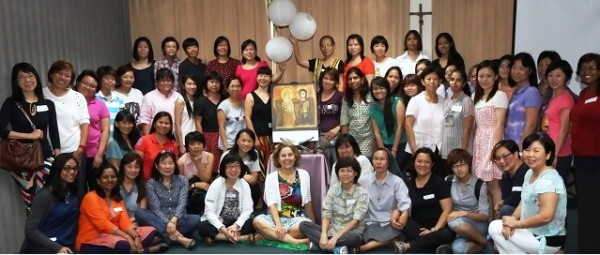
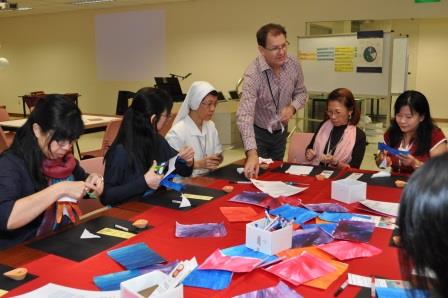
These were the foci of a series of workshops for Catholic School and Preschool educators, conducted by Dr Margaret Carter and organised by the Archdiocesan Commission for Catholic Schools (ACCS).

Dr. Carter, who is a Senior Lecturer in Education at James Cook University, Australia, is a behaviour-change specialist currently based in Queensland. She has worked for profit and non-profit community agencies, education systems, regional indigenous and non-indigenous groups and individuals on social and emotional well-being and behaviour change for children and adults. Dr. Carter has published many books on children’s and young people’s social behaviour and is familiar with the Singapore educational environment, having spent two and a half years in Singapore (until June 2013) lecturing for James Cook University, Singapore (subject coordinator and lecturer for their Master of Education; Master of Guidance and Counselling; Graduate Certificate Career Development; Graduate Certificate Research Methods; Graduate Certificate of Education – Academic Practice). In Australia, Dr Carter has conducted workshops for the Catholic Archdiocese of Brisbane and for the Australian Catholic University (on educational leadership and behaviour management; educational leadership and spirituality).

Dr Carter remains an invited member of both the ethics subcommittee and the clinical supervision subcommittee for the Singapore association for counselling. Her current areas of research are: Cyber bullying; Learning in the virtual world; Third culture kids; Young children’s social capacity.

The first workshop, which took place on Thursday 20th March in the Catholic Adult Education Centre, was conducted for all the educators of the two preschools belonging to the Good Shepherd Sisters (Marymount Kindergarten and Good Shepherd Convent Kindergarten), for their before- and- after- care school staff and crisis centre staff, as part of their Internal Professional Development Programme, by request of their supervisor, Tan Poh Cheng. “It’s been an excellent session: Dr Carter is engaging, experienced and relates well with the participants. The session was well planned and the concepts clearly explained and demonstrated through videos and examples” was Tan Poh Cheng’s feedback at the end of the workshop which was attended by fifty-three preschool educators.

The second workshop was open to all the educators of Catholic preschools and it was part of their Professional Development Programme for Character Education. With fifty-one participants, it followed the same structure as the one on the previous day.

During both workshops Dr Carter stressed that, when teaching values to preschool children, it is fruitless to just ‘tell’ them what to do (i.e. saying ‘use kind words!’). Adults need to model the desired value: for example, when teaching ‘respect’, adults must not assume that children have an innate understanding of the word respect or that they have necessarily experienced being treated with respect. The road to mastery starts with defining and explaining what is meant by ‘respect’, followed by role playing or modelling by the teacher, moving on to providing practice and guidance in real life contexts, followed by re-teaching whenever necessary and continued practice until the virtue is mastered. Modelling and consistency are paramount and adults must be on guard lest they themselves should be caught using unkind language towards the children.

The system of routines in place in each educational setting can either support or hinder the learning of values and social behaviour. In the second half of the workshops, participants were encouraged to examine their own preschool’s routines through role plays and, once a problem was identified, come up with solutions by pooling together ideas and wisdom with their peers. “I was enlightened to reflect on children’s behaviour by analysing within-the-child factors, our institutional and environmental factors” commented Lim Kiah Pin, from Canossian Convent Kindergarten.

One new insight for Margaret Spruyt, a teacher from Good Shepherd Convent Kindergarten, was the realisation of the power of language in dealing with children: “It is very important to use the right language (or words) to speak to young children as it may help to enhance the child’s self-esteem or destroy the child’s confidence.”

“I will try to apply what I’ve learnt during my day-to-day interaction with the children and whenever I’m teaching them” shared Ann, from Canossian Convent Kindergarten.

The two workshops for preschool educators were part of the training and support offered to all Catholic Preschools following the launch (last December) of a new Integrated Curriculum for Catholic Preschools in Singapore, written by ACCS under Dr Carter’s guidance. The new curriculum integrates the Academic core with the Character Education and the Religious Education components, under eight broad themes (for example: ‘Me and my family’, ‘Anti-bias’, ‘People at work’) and has been made available to all Catholic Preschools. The new themes for term 2, which have been fine-tuned in the light of the feedback from the trials and in consultation with the schools, were introduced by ACCS Preschools Project Director, Merilyn Dasson, during the workshops.

Given the current emphasis given by the Ministry of Education to Character and Citizenship Education in the framework of a holistic education, ACCS invited, for the first time, Primary and Secondary School educators to Dr Carter’s workshops during two dedicated sessions which took place on the 24th and the 25th of March (for Primary and Secondary School educators respectively). The workshops involved group work and sharing by three schools about how they conduct Values Education and Values in Action programmes. According to Dr Carter, it takes only one person who is passionate about values education, who starts to interact and live the experience of the values, for the rest of the school to be influenced and eventually ignited. This person, however, needs a patron (a colleague or a leader) for support. This patron might not be passionate about values education but curious and interested to provide the needed assistance.

For each of the core values of the Character and Citizenship education programme , Dr Carter started by asking the participants to brainstorm a definition, then moved on to identifying what they look like vs what they do not look like. Then, Dr Carter went through examples of how to demonstrate the value in practice and how to create an environment where this is possible. Dr Carter stressed that values don’t just happen but need to be intentionally taught and teachers need to demonstrate them conscientiously and consistently. Twenty-two Primary School Teachers and thirteen Secondary School Teachers attended the workshops.

Among them was Lesley Goonting, chaplain of CHIJ Our Lady of Good Counsel, who commented that she gained a new insight on “the critical role ‘consistency’ plays in developing and nurturing a value education experience. Its effects need to be pervasive, engage all and be aligned/cascaded at all levels, programmes and in all interactions.”

For Br Dominic Chong, chaplain and brother in residence of SJI Junior, one new insight gained from the workshop was that “we, as teachers, can only influence our pupils on Value Education to the extent that we are already practising those values; we should periodically check ourselves on how do we see our pupils…as gifts entrusted by God or just as mere digits in the classroom.”

Dr Carter’s visit to Singapore has also served the purpose of conducting interviews with the children and the parents of the preschools which have trialled the new Integrated Curriculum. Upon request by other Catholic preschools, Dr Carter has agreed to comeback to Singapore for further school visits and workshops in August.


This article was published in Catholic News, April 20, 2014, Volume 64, Number 08

30 March 2014

|

Tags: Educators, Parents, Students

|

Categories: Homilies / Messages, News

My Dear Brothers and Sisters in Christ,

Some of you may have heard or read about the Frequently Asked Questions (FAQ) on Sexuality posted on the Health Promotion Board (HPB) website.

I want to assure you that our non-public engagement of the opposing groups on this issue is by no means evidence of our flight from our Christian calling to speak the truth and to defend the cause of the family and hence, of society and the future of humanity. My Consultors and I have chosen to take the path of constructive dialogue with the authorities, so as not to inflame the situation further and risk polarizing society.  As in all politically and socially sensitive issues, we believe that the best way forward is for all to calmly and purposefully engage in constructive dialogue in a spirit of patient understanding, mutual respect and compassion, always working towards the promotion of justice and dignity of the individual and for the greater good of society.

Accordingly, we have shared the Church’s concerns with the authorities and they have assured us that the government has not changed its position on the family (comprising heterosexual couples with children) as the indispensable, basic building block of society.  As Church, we will continue to engage and work with the relevant authorities to ensure that the marriage institution and family values are upheld so that our children can be formed in an environment that is holistic, nurturing, caring and loving. We also need to ensure that society does not become too individualistic in pursuing their needs at the expense of the greater good of society. Because the future of Singapore society and humanity at large passes by way of the family, every Catholic should endeavor to save and foster the values and requirements of the family.  This call is urgent and important because if the family is destroyed, then our society would become fragmented.

That said, I am also aware that some of our faithful are confused and are struggling to come to terms with their own sexuality, or that of their loved ones.  I wish to take this opportunity to assure you that the Church feels with you and views every individual as unique and precious in the eyes of God, regardless of his/her sexual inclination or state of life.  However, the Church’s position on the matter of LGBT relationships has always been consistent; that sexual activity outside of a heterosexual relationship is not in accordance with the laws of creation because such acts are not open to new life.  It is in this spirit of compassion that I am exploring the setting up of support groups to assist those who are struggling with same sex attraction and their loved ones who have difficulty accepting them.

Finally, I urge you, my dear faithful, to continue to pray with me for all those who are confused, fearful and struggling with their sexuality, that the Lord will guide, protect and strengthen them, especially in their most vulnerable moments and bring them healing and peace of mind. May the Lord, who created all things and proclaimed that ‘it is good’, renew the face of the earth.


+ Archbishop William Goh

10 February 2014

|

Tags: Educators

|

Categories: Reflections

Ng U-Lynn, an Art teacher in St Gabriel’s Secondary School, shares a day with us.


A book with a prayer for every day of the year (“The Power Of A Praying Woman”, by Stormie O’Martian) stands prominently on U-Lynn’s desk, in the staffroom of St Gabriel’s Secondary School.

Prayer, in many forms (this prayer calendar and partaking in the living rosary – a prayer group made up of 15 members- to which she belongs, after suggestion by one of her Catholic colleagues), is a permanent companion for U-Lynn. “What gives me strength is Faith, through constant prayer. When you pray you keep yourself close to God, you will hear his voice and he will give you strength to pull through tough days… what I love about this school is that every morning we have ‘morning sharings’ by staff and students during assembly, which gives me a sense of peace and calm to start the day with. (We take a little verse from the Gospel and we expand on it; different teachers and students are scheduled to talk about it, on a roster, while the principal always shares on Tuesday). It’s just a five minutes’ sharing but I think it’s important because we start the day with the Word of God. I know this calms the students: they understand it is a sacred time and they keep very quiet, even if they are from a different religious background.”


U-Lynn’s faith and prayer life are not the only source of her strength and good cheer: on many occasions during her interview, U-Lynn mentioned the support of her colleagues. As Bro John Kallarackal mentioned in his keynote speech at the recent Montfortian Education Symposium, the quality of the relationships between members of staff is very important in a school. U-Lynn finds that her colleagues, like “human angels” are always there to support her when she needs it. “My family is also my source of comfort and joy and I thank God every day for my family and friends”.

“There are many challenging times in teaching because we are dealing with teenagers. You have 40 students in a class with different characteristics and needs” says U-Lynn. “You need a ‘bag of tricks’ to tackle different situations: when a child is distracted, disrespectful or constantly wanting your attention. You must always show that you are in control, even when you feel that a storm is brewing inside of you. You must rise above your emotions towards the things that happen around you and ride on the Lord’s strength. On rough days, my colleagues and family are always there to support me, to give me a pat on the shoulder and provide words of comfort. Your friends in school are like your family: with them, you can pull through anything.”


“We, teachers, are under a lot of pressure: we teach many classes, each class has forty students, we have to mark, we have meetings, sometimes workshops, extra classes, we have to supervise CCAs… the tasks that go on everyday can overwhelm a person and it’s a struggle that every teacher goes through and so we understand each other. But when you have great colleagues, it is a comforting joy that’s indescribable and reassuring. Most importantly, when you have God in your life: St. Paul says “I can do all things through Christ who strengthens me”(Phil 4:13)- I keep this verse very close to my heart. Only God can keep our spirits unwavering and at peace amidst the storm. As human beings, I know my limitations and there are days when I am swamped with work and tempted to skip prayer. But I tell myself, say short prayers like ‘thank you Lord for a beautiful day’ or ‘I love you Jesus’ or ‘Help me Jesus’, even just a short prayer to keep me close to God. I also try to make use of the chapel in the school, a place of peace and solitude where staff and pupils can go to pray, undisturbed”.


U-Lynn has taught Art for almost 15 years and there was a time when she was teaching in a co-ed school: “I remember most vividly this particular student of mine who was in a dire situation: she was the only child and the sole breadwinner of her family. Her dad had left them, while her mum was sick and unable to work. This girl was studying for her GCE O-level Examination and also working in MacDonald’s five afternoons per week to tide her family over. She would study at night, under the light of a candle because they could no longer pay for electricity. She faced many obstacles in life but despite the odds coming at her, she persevered and told me that she would work very hard to get a distinction for Art and she did. She is now an Art teacher and words cannot express the amount of pride I feel towards her and I always tell her story to my students to inspire them. Sometimes students inspire teachers, not just the other way round!”


U-Lynn also teaches catechism to Secondary 1 students and is a member of the school’s Catholic Teachers’ Committee: “Having Catholic colleagues in school is great: there’s an unspoken bond between us.” Asked if there is any resentment among the Catholic Teachers’ Committee about the extra work (catechism, liturgy preparation) that they do in the school, she replies: “Not that I know of” she replies. “We meet in the Catholic Teachers’ Committee to share the jobs and we volunteer for what we like to do. Some people volunteer for more than one job!”

“Overall, there are more good days than bad days:” says U-Lynn with a smile, “the best reward is when your students do their best in your subject. And on Teachers’ Day I love receiving little letters and cards from the students, they are the best gift as cards and letters affirm you and remind you of why you’re in this profession in the first place.”


Read Blessed Pope John Paul II’s “Letter to Artists”, dedicated “To all who are passionately dedicated to the search for new ‘epiphanies’ of beauty so that through their creative work as artists they may offer these as gifts to the world”.

1 August 2013

|

Tags: Educators, Parents, Students

|

Categories: Homilies / Messages

The following is an extract from the CMECS (Civics and Moral Education for Catholic Schools): Foundations for Sexuality Education Programme, created by the Family Life Society (FLS) in collaboration with ACCS.


The prevalent perspective on sexuality says “I am free to do what I want (with my body) provided I don’t hurt anyone” and “My body belongs to me (just like my handphone, my clothes, my computer, etc…)”. But this is not true for at least four reasons:

  1.  My body is me and I am my body: “Me” and “My Body” are like two layers of a rolled cake and they cannot be separated without breaking the entire cake. Neither of the two layers is closer to the core, the most intimate “me”, as they are wrapped together all the way to the centre. Ultimately, accessing the most intimate parts of my body means accessing the most intimate part of me. The intimacy of the body is the intimacy of the person. Saying ” our relationship is just physical” makes no sense.
  2. My body communicates with a language I cannot change: sex is always personal. The idea of separating intimacy of the body from intimacy of the person is floored also on another account: the body communicates with a language which is independent of our intentions, of our culture or social norms. Even if I said: “With this slap I meant to tell you “I love you”; the message received by the slapped cheek would not be one of love. Our body speaks for us with its own unchangeable language.
  3. What is personal must never be “used”: the sexual aspect of the body is always personal and intimate and communicates a personal and intimate union and must never be used as a means to other ends (i.e. sex for grades, prostitution);
  4. My decisions make me: my decisions not only change the world outside me but also change something in me that shape my character and the kind of persons I become.

Education is more than information about facts and consequences. To educate is to accompany persons in their development by providing skills to become better persons.


The full CMECS programme on Foundations for Sexuality Education for use with Sec 3 students can be obtained from ACCS. Workshops for teacher are also available (free of charge) at ACCS or in schools by mutual arrangement. Contact us for more details.

20 December 2012

|

Tags: Educators

|

Categories: Events, News

Catholic educators who took part in a training programme run by a team from Brisbane, Australia, said they gained much from it.

The course “introduced to me the many strategies we can adapt, e.g. using colours, mind scaffolding, music, art and dance, and using all the wonderful things of God’s creation to aid us in our teaching sessions,” said Mr Bernard Lim, a Catholic preschool board member.

“We were exposed to new tools through technology which enhances traditional materials,” said Ms Irene Leong, principal of Nativity Church Kindergarten.

“Every single activity that we experienced and enjoyed may be used with our students and, most importantly, was meaningful for ourselves.”

Mr Lim and Ms Leong were among 52 teachers from Catholic preschools, primary and secondary schools who attended the Religious Education Training Programme held at Catholic Junior College from Nov 26-29.

The Archdiocesan Commission for Catholic Schools (ACCS) in Singapore conducted the programme in conjunction with the Brisbane Catholic Education office, which sent a six-person team.

“More than anything, an RE [religious education] teacher should know that who they are as an authentic human being is just as important as what they teach,” Mr Mark Elliott, Principal Education Officer of Religious Education with the Brisbane office told CatholicNews.

“RE teachers need to have a deep understanding of scripture and be prepared to challenge students to recognise the person of Jesus not just in scriptural texts but in everyday life.”

According to Ms Merilyn Dasson, director of early childhood education at ACCS, the aim of the programme is for “religious educators to be able to infuse a genuine spirituality into the school and especially in RE classes”.

Some Catholic preschool teachers are also expected to go for a week’s attachment at a Catholic kindergarten in Brisbane next year.


This article was published in Catholic News (December 16, 2012, Vol 62, No 25).

26 November 2011

|

Tags: Educators

|

Categories: Reflections

Nick Chui, 35, does not teach in a Catholic school, but that does not change his purpose and calling.


Why did you want to be a teacher? What were you doing before becoming a teacher?
I was involved in delivering presentations on sexuality education and writing articles explaining and if necessary defending Catholic teaching in the area of marriage, family and pro-life issues in my previous job. I was also a catechist at the same time. I felt that I was making some impact on the students but my encounter with students was usually one off or over a limited period of time. As a teacher I felt that I could impact my students to think critically, write well, and plant seeds of the Word in their hearts so that they would be drawn to the possibility of authentic love and purpose.

What is the biggest challenge you face as a Catholic educator?
To be constantly conscious of the presence of the Holy Spirit in whatever I do.

If you weren’t a teacher today, how different would your life have been?
I think without the daily encounter with my students, the practice of my faith may lack a concrete pastoral focus. Pope Francis speaks to Christians, challenging them to go “out to the periphery.” He believes that “A church that doesn’t get out, sooner or later, gets sick from being locked up”. From the point of view of faith, teaching in a government school is indeed a periphery. I am one of two Catholics in the school. Can I witness to Christ in such circumstances and be inspired by the Church’s teaching? Previously, I tended to speak at the ‘theoretical level.” With this daily encounter with students, I am able to share and see how what I have written and thought about on a “theoretical” level is translated in concrete life circumstances.

What is your fondest memory/experience as a teacher?
Being voted “most encouraging teacher” by students for the second year running. When students spontaneously share that they miss your lesson or when they recall something you say and apply it as a life lesson, it makes my day. I hope that I am being an encouragement to them in the manner Christ would have wanted.

What do you like most about being a Catholic?
Knowing that I am loved by Jesus Christ and being able to encounter him in the Eucharist. Also, knowing that I am a member of the community he founded, the Catholic Church, built upon the rock of Peter and the apostles.

What do you like most about being a teacher?
The opportunity to imitate and draw inspiration from Christ the teacher.

Has your faith affected you in your role as a teacher in any way?
My faith affects my role as a teacher in every way. Faith offers a vision, a way to approach things, the way Christ would approach it, as he preached and built the Kingdom of God. When I am tired of teaching a class, my conscience prompts me to go the extra mile for a student, even though he or she may not be grateful. It affects me so that I would speak out in situations which I consider unjust. It affects me in my relationships with my colleagues and parents.

What are some of your key priorities as a teacher?
A key priority for me is to find meaning in all I do and help my students to find meaning too. Meaning and purpose are the keys which drives human action. It is the foundation without which life would be existentially boring. Existential boredom usually lead to poor academic grades and disciplinary issues.

What is one way you try to inspire your students?
I share with them my life experiences, I am not a perfect person, but I have found Christ and meaning. I would like my life to be a dialogue with theirs, to aspire together to higher standards as these standards are not mine per se, but what fulfils a human person. I avoid hypocrisy and am not afraid to apologise when I have done something wrong.

Do you try to share your faith with students? How so?
Yes I do. My students will quickly discover that I am Catholic as I would share this as I introduce myself to them. Some will approach me and chat about life and its purpose. This inevitably leads to questions about religion. Nevertheless, I will however always put on record that I will never force my students to accept my opinions about life. While I may be the “expert” in a particular subject, I am a “co-pilgrim” when it comes to life and its meaning.

While teaching history and English literature is not explicitly about Jesus Christ, I am nevertheless very conscious that in Christ, “He is before all things, and in Him all things hold together.” (1 Col 1:17). The truths in history or English literature are never unrelated to Christ. When I teach my students how to think critically, how to empathize, how to write a good paragraph, I am doing the work of building the kingdom, of doing my part in forming human beings into intelligent and good people.

I am also one of the teachers involved in Boys Brigade, a Christian organization. In the Boys Brigade, we can talk about Christ and the message of his kingdom in an explicit manner.

How do you keep close to God?
By praying the liturgy of the hours, Lauds and Vespers, meditating on the scriptures, praying the rosary, and attending weekday Masses if possible.

What brings you joy in life?
Knowing that I am loved, that the world is loved, and that all will be well in the end.

What do you like to do in your spare time?
I play chess. I am also involved in the Legion of Mary and the Catholic Theology Network, a gathering of Catholics interested in theology.

What is your favourite scripture passage?
“Though he was in the form of God, Jesus did not regard equality with God something to be grasped. Rather, he emptied himself, taking the form of a slave, coming in human likeness; and found human in appearance, he humbled himself, becoming obedient to death, even death on a cross. Because of this, God greatly exalted him and bestowed on him the name that is above every name.” (Phi 2:6-9)

10 January 2011

|

Tags: Educators, Parents, Students

|

Categories: Homilies / Messages, News

Dear Principals, Vice-Principals and Heads of Department in our Catholic Schools,

Greetings for the New Year! My prayers and blessings on all of you as you begin a new academic year.

On the occasion of the World Day for Peace on January 1st our Pope Benedict has dedicated his message to peace which he connects closely to religious freedom. He says “The right to religious freedom is rooted in the very dignity of the human person, whose transcendent nature must not be ignored or overlooked. God created man and woman in his own image and likeness (cf. Gen 1:27). For this reason each person is endowed with the sacred right to a full life, also from a spiritual standpoint. Without the acknowledgement of his spiritual being, without openness to the transcendent, the human person withdraws within himself, fails to find answers to the heart’s deepest questions about life’s meaning, fails to appropriate lasting ethical values and principles, and fails even to experience authentic freedom and to build a just society.”

I would like to reiterate with the Pope, the importance of the Spiritual and Ethical dimensions of human life and the importance of religious freedom which is to be exercised appropriately. As we begin a new school year I pray that all our Catholic Schools remember that we have a duty and a right to nurture our Catholic identity for the benefit of all our students.

Many of you have requested that the Catholic Church teachings be clarified in the area of Pre-Marital Sex and Contraception in the context of the sexuality programmes that are taught in our schools.

Firstly, we acknowledge that we live in a secular society where no specific religious group has the right to impose its beliefs on others. Within the context of our Catholic Schools however I would find it unacceptable if students were given a compromised message on pre-marital sex. This applies to all students in the school.

Secondly, we are very concerned with the increasing incidence of sexually transmitted infections among students caused by young people indulging in sexual activity with multiple partners. We would like to collaborate with the Health Promotion Board to do whatever is best for our young people in this regard.

We are convinced that the solution to our problems is not to compromise but to remain faithful to what has been proven beneficial to the human person and supports the dignity and sacredness of human love and life. As you have asked for a statement on the Church’s teachings I have prepared some paragraphs below for you to study and apply in sexuality education programmes that are to be delivered in our schools.

The Church’s official teaching

The official teaching of the church regarding sexual intercourse (the marital act) and contraception has been consistently taught both in the tradition and in the official Magisterium of the church.

Pius XI in 1930 wrote in the encyclical Casti Connubi: “any use whatsoever of matrimony exercised in such a way that the act is deliberately frustrated in its natural power to generate life is an offense against the law of God and of nature, and those who indulge in such are branded with the guilt of a grave sin.” (CC 56). 

At the time, this teaching was simply unquestioned and accepted by a church and culture that appreciated the value of fertility and offspring. The “sexual revolution” of the 60’s sought to question traditional sexual values and behavior while the invention of oral contraceptives made some theologians raise new questions on the traditional teaching of the church regarding contraception.

After much debate, in 1968 in the after-math of the Second Vatican Council, Pope Paul VI published the encyclical Humanae Vitae reiterating the previous position of the church: “The Church… teaches that each and every marital act must of necessity retain its intrinsic relationship to the procreation of human life.” (HV 11) In another place it reads “every action which… proposes whether as an end or as a means, to render procreation impossible is intrinsically evil” (HV14). 

This teaching has been reaffirmed by John Paul II in his Apostolic Exhortation of 1981,Familiaris Consortio and offered to the faithful in the teachings of the ‘Catechism of the Catholic church’ as follows: “the two meanings or values of marriage cannot be separated without altering the couple’s spiritual life and compromising the goods of marriage and the future of the family” (CCC 2362).

Two things we should stress from these texts: First, there is no mention of any particular means of contraception, since what is at stake is not the method used or whether this method is natural or artificial. What is at stake is the moral act of contraception. Thus, whether the choice to contracept is done through the use of condoms, oral hormones, behavior (such as the “so called” withdrawal method) or simply a general attitude or mentality against the conception of a child, what spouses choose to do is to render their marital life sterile.

A second point we need to stress is this teaching concerns marital acts, since marital acts are the only ethical sexual acts in the eyes of the church. The teaching of the church is concerned with the faithful preservation of the teachings of Jesus Christ and its application in different times and places to assist Christians to lead lives consistent with their status as children of God.

If we present to our young people how to use the condom outside marriage, just in case you need it, it would be as though the church is teaching us how to sin less grievously which makes no sense. Thus, we do not find official teachings of the church on the uses of contraceptives in extramarital or homosexual sex.

So far, we have sought to clarify the stand of the church regarding contraception. The question remains though whether it would be better to use contraceptives in cases of unethical sexual intercourse for the sake of preventing a contagion of diseases. There is no official teaching of the church on this point and we are left to the discussion of theologians and other authorities on this point.

The use of condoms
First of all, we must note that condoms, even if invented or commonly used to prevent the transmission of life, are now also used to prevent the transmission of death. Condoms in that sense would not be primarily an instrument of contraception but an instrument of prevention of the spread of a disease. In fact, condoms, when used in homosexual acts, cannot be contraceptive at all, since the homosexual act is never a conceptive act in the first place.

So, even when extra-marital sex is intrinsically wrong, wouldn’t it be better that these wrong acts, would be rendered “less irresponsible and dangerous” by protecting the participants of the sexual act with a condom? Bishop Anthony Fisher, Australian Bishop and a member of the Pontifical Academy for Life, thinks so: “Whether and when condoms are effective for preventing disease transmission is complex (…). But prima facie, while extra-marital intercourse is always wrong because it is unchaste, the intention of reducing the danger to health by wearing a condom is a good one and the actual act is indifferent.”

However, his argument does not conclude there. He continues: “On the other hand, insofar as using a condom lends a true – or, more likely, false – sense of security to sexual activity it may make the user more likely to engage in wrongful intercourse and so condomizing intercourse can aggravate the wrong. As such, the activity becomes habitual it further clouds people’s understanding of sexuality, and accustoms them to ways of thinking and relating that will make it more difficult for them ever to enter profoundly into marital communion.  Condoms may be ‘safer’ but they certainly do nothing for people’s chastity!” [Anthony Fisher, Cooperation, Condoms and HIV (Henkels Lecture for Bioethics Symposium on Moral Conviction vs Political Pressure, Institute of Bioethics at Franciscan University of Steubenville, Ohio USA)]

Some theologians argue that if contraception is wrong in itself, couples who engage in the sexual act outside marriage, when they use contraceptives are in fact adding a new wrong to their already wrong act of extra-marital sex.

Another debated issue is whether married couples could use condoms if one partner is infected with the HIV virus. Cardinals and other ecclesiastical authorities have defended condom use by married couples to prevent transmission of HIV. Examples of these are Carlo Cardinal Martini, Cardinal Javier Lozano Barragán, former president of the Pontifical Council for Health Care Workers, Cardinal Danneels of Belgium and George Cottier, O.P., former theologian to John Paul II.

The opposite opinion is also held that such acts would not be true marital acts, since they would prevent the act from being fully a sexual marital act because it precisely prevents its consummation.

Recently, in the book-interview “Light of the World”, the Pope made some comments regarding the seemingly responsible use of condoms by male prostitutes. The Press understood this as an exception to the normal policy of the church against condoms and a possible change of vision in the church’s doctrine on contraception. The Press has spread this message far and wide, without much clarity.

The statement of Benedict XVI commenting on the special case of “male prostitutes” is not one more opinion on either side, but a deeper statement. He sees in the undeniably good intention of the prostitute a “movement towards the good” even within the wrongness of the act. The statement of the Pope goes beyond the individualistic morality of the case per se towards a more holistic approach.

Conclusion
I am deeply grateful to all of you for your care of the young and their moral and spiritual development as well as their intellectual and physical growth. My prayers accompany all your efforts.

Let us have the courage of our convictions and bring true education and values into sexuality and all other subjects and aspects of school life.


Your brother and friend,
+Archbishop Nicholas Chia
10 January 2011

20 September 2010

|

Tags: Educators, Students

|

Categories: Homilies / Messages, News

As part of the Papal Visit to the UK in 2010, Pope Benedict XVI visited St Mary’s University in Twickenham. There, he met 3,500 school children and students to celebrate Catholic education at ‘The Big Assembly’ event. This was the speech the Holy Father gave to the students.


Dear Brothers and Sisters in Christ,
Dear young friends,

First of all, I want to say how glad I am to be here with you today. I greet you most warmly, those who have come to Saint Mary’s University from Catholic schools and colleges across the United Kingdom, and all who are watching on television and via the internet. I thank Bishop McMahon for his gracious welcome, I thank the choir and the band for the lovely music which began our celebration, and I thank Miss Bellot for her kind words on behalf of all the young people present. In view of London’s forthcoming Olympic Games, it has been a pleasure to inaugurate this Sports Foundation, named in honour of Pope John Paul II, and I pray that all who come here will give glory to God through their sporting activities, as well as bringing enjoyment to themselves and to others.

It is not often that a Pope, or indeed anyone else, has the opportunity to speak to the students of all the Catholic schools of England, Wales and Scotland at the same time. And since I have the chance now, there is something I very much want to say to you. I hope that among those of you listening to me today there are some of the future saints of the twenty-first century. What God wants most of all for each one of you is that you should become holy. He loves you much more than you could ever begin to imagine, and he wants the very best for you. And by far the best thing for you is to grow in holiness.

Perhaps some of you have never thought about this before. Perhaps some of you think being a saint is not for you. Let me explain what I mean. When we are young, we can usually think of people that we look up to, people we admire, people we want to be like. It could be someone we meet in our daily lives that we hold in great esteem. Or it could be someone famous. We live in a celebrity culture, and young people are often encouraged to model themselves on figures from the world of sport or entertainment. My question for you is this: what are the qualities you see in others that you would most like to have yourselves? What kind of person would you really like to be?

When I invite you to become saints, I am asking you not to be content with second best. I am asking you not to pursue one limited goal and ignore all the others. Having money makes it possible to be generous and to do good in the world, but on its own, it is not enough to make us happy. Being highly skilled in some activity or profession is good, but it will not satisfy us unless we aim for something greater still. It might make us famous, but it will not make us happy. Happiness is something we all want, but one of the great tragedies in this world is that so many people never find it, because they look for it in the wrong places. The key to it is very simple – true happiness is to be found in God. We need to have the courage to place our deepest hopes in God alone, not in money, in a career, in worldly success, or in our relationships with others, but in God. Only he can satisfy the deepest needs of our hearts.

Not only does God love us with a depth and an intensity that we can scarcely begin to comprehend, but he invites us to respond to that love. You all know what it is like when you meet someone interesting and attractive, and you want to be that person’s friend. You always hope they will find you interesting and attractive, and want to be your friend. God wants your friendship. And once you enter into friendship with God, everything in your life begins to change. As you come to know him better, you find you want to reflect something of his infinite goodness in your own life. You are attracted to the practice of virtue. You begin to see greed and selfishness and all the other sins for what they really are, destructive and dangerous tendencies that cause deep suffering and do great damage, and you want to avoid falling into that trap yourselves. You begin to feel compassion for people in difficulties and you are eager to do something to help them. You want to come to the aid of the poor and the hungry, you want to comfort the sorrowful, you want to be kind and generous. And once these things begin to matter to you, you are well on the way to becoming saints.

In your Catholic schools, there is always a bigger picture over and above the individual subjects you study, the different skills you learn. All the work you do is placed in the context of growing in friendship with God, and all that flows from that friendship. So you learn not just to be good students, but good citizens, good people. As you move higher up the school, you have to make choices regarding the subjects you study, you begin to specialize with a view to what you are going to do later on in life. That is right and proper. But always remember that every subject you study is part of a bigger picture. Never allow yourselves to become narrow. The world needs good scientists, but a scientific outlook becomes dangerously narrow if it ignores the religious or ethical dimension of life, just as religion becomes narrow if it rejects the legitimate contribution of science to our understanding of the world. We need good historians and philosophers and economists, but if the account they give of human life within their particular field is too narrowly focused, they can lead us seriously astray.

A good school provides a rounded education for the whole person. And a good Catholic school, over and above this, should help all its students to become saints. I know that there are many non-Catholics studying in the Catholic schools in Great Britain, and I wish to include all of you in my words today. I pray that you too will feel encouraged to practise virtue and to grow in knowledge and friendship with God alongside your Catholic classmates. You are a reminder to them of the bigger picture that exists outside the school, and indeed, it is only right that respect and friendship for members of other religious traditions should be among the virtues learned in a Catholic school. I hope too that you will want to share with everyone you meet the values and insights you have learned through the Christian education you have received.

Dear friends, I thank you for your attention, I promise to pray for you, and I ask you to pray for me. I hope to see many of you next August, at the World Youth Day in Madrid. In the meantime, may God bless you all!


Given at the Sports Arena of St Mary’s University College, Twickenham
17 September 2010

Source: thepapalvisit.org.uk
Photo credit: thepapalvisit.org.uk

19 September 2010

|

Tags: Educators

|

Categories: Homilies / Messages, News

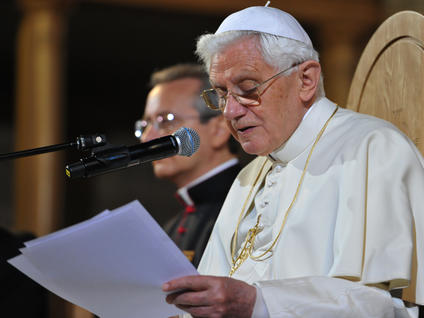
As part of the Papal Visit to the UK in 2010, Pope Benedict XVI visited St Mary’s University in Twickenham. There, in the first event of the day the Holy Father prayed with representatives of religious congregations, including those who have a charism for education and the history of education, in the University Chapel.


Your Excellency the Secretary of State for Education,
Bishop Stack, Dr Naylor,
Reverend Fathers, Brothers and Sisters in Christ,

I am pleased to have this opportunity to pay tribute to the outstanding contribution made by religious men and women in this land to the noble task of education. I thank the young people for their fine singing, and I thank Sister Teresa for her words. To her and to all the dedicated men and women who devote their lives to teaching the young, I want to express sentiments of deep appreciation. You form new generations not only in knowledge of the faith, but in every aspect of what it means to live as mature and responsible citizens in today’s world.

As you know, the task of a teacher is not simply to impart information or to provide training in skills intended to deliver some economic benefit to society; education is not and must never be considered as purely utilitarian. It is about forming the human person, equipping him or her to live life to the full – in short it is about imparting wisdom. And true wisdom is inseparable from knowledge of the Creator, for “both we and our words are in his hand, as are all understanding and skill in crafts” (Wis 7:16).

This transcendent dimension of study and teaching was clearly grasped by the monks who contributed so much to the evangelization of these islands. I am thinking of the Benedictines who accompanied Saint Augustine on his mission to England, of the disciples of Saint Columba who spread the faith across Scotland and Northern England, of Saint David and his companions in Wales. Since the search for God, which lies at the heart of the monastic vocation, requires active engagement with the means by which he makes himself known – his creation and his revealed word – it was only natural that the monastery should have a library and a school (cf. Address to representatives from the world of culture at the “Collège des Bernardins” in Paris, 12 September 2008). It was the monks’ dedication to learning as the path on which to encounter the Incarnate Word of God that was to lay the foundations of our Western culture and civilization.

Looking around me today, I see many apostolic religious whose charism includes the education of the young. This gives me an opportunity to give thanks to God for the life and work of the Venerable Mary Ward, a native of this land whose pioneering vision of apostolic religious life for women has borne so much fruit. I myself as a young boy was taught by the “English Ladies” and I owe them a deep debt of gratitude. Many of you belong to teaching orders that have carried the light of the Gospel to far-off lands as part of the Church’s great missionary work, and for this too I give thanks and praise to God. Often you laid the foundations of educational provision long before the State assumed a responsibility for this vital service to the individual and to society. As the relative roles of Church and State in the field of education continue to evolve, never forget that religious have a unique contribution to offer to this apostolate, above all through lives consecrated to God and through faithful, loving witness to Christ, the supreme Teacher.

Indeed, the presence of religious in Catholic schools is a powerful reminder of the much-discussed Catholic ethos that needs to inform every aspect of school life. This extends far beyond the self-evident requirement that the content of the teaching should always be in conformity with Church doctrine. It means that the life of faith needs to be the driving force behind every activity in the school, so that the Church’s mission may be served effectively, and the young people may discover the joy of entering into Christ’s “being for others” (Spe Salvi, 28).

Before I conclude, I wish to add a particular word of appreciation for those whose task it is to ensure that our schools provide a safe environment for children and young people. Our responsibility towards those entrusted to us for their Christian formation demands nothing less. Indeed, the life of faith can only be effectively nurtured when the prevailing atmosphere is one of respectful and affectionate trust. I pray that this may continue to be a hallmark of the Catholic schools in this country.


Given at the Chapel of St Mary’s University College, Twickenham
17 September 2010

Source and photo credit: thepapalvisit.org.uk