28 May 2015

|

Tags: Educators

|

Categories: Reflections, Saints

As we end the month Mary, let us reflect and remind ourselves again of the important lessons Our Lady teaches us by her example.


The special dedication of the month of May to the Blessed Virgin Mary has long been a tradition of the Catholic Church, where the faithful engage in more fervent and loving acts of homage and veneration. In the midst of prayer and deeper reflection, Mary’s May is the opportune time to look once again on Mary’s “yes”, and what her example teaches us.

From the accounts of several saints and from the various approved Marian apparitions throughout history, we see that the Blessed Virgin is in fact, not only a loving mother and intercessor, but also a great educator for all Christians.

There are many great lessons that Mary teaches us, but there are two aspects in which we, as educators, can draw special reflection – Mary’s role as teacher during her time on earth, and the “school” of her Immaculate Heart.

The teacher’s teacher

Learning about Mary from the accounts of the Gospels, it is natural and beneficial for us to view her as our dear mother and guide. However, the Gospels also certainly tell of Mary’s role as our teacher, such as when she instructed the servants at the wedding at Cana, “do whatever He tells you” (John 1:5).

Education was in fact one of the major responsibilities of Mary, albeit lesser known. This is seen most clearly in her duty of teaching Jesus and bringing Him up in this world according to God’s plans.

Though we do not have more detailed accounts of Jesus’ early life, His nature as both fully God and fully man, who went through normal human growth, certainly makes the case of Mary’s role as teacher of Jesus undeniable.

In the Catechism of the Catholic Church, the duty of parents and educators is in fact described as inseparable, as “parents have the first responsibility for the education of their children. They bear witness to this responsibility first by creating a home where tenderness, forgiveness, respect, fidelity, and disinterested service are the rule” (CCC 2223).

Mary has been blessed with the authority to be a worthy enough educator to Jesus because she was filled with graces from the Holy Spirit. When the angel visited her, the greeting started with the famous, “Hail, full of grace, the Lord is with you!” (Luke 1:28).

At the same time, it is important to also note that the graces which Mary has been blessed with certainly required her obedience, as she would not have been a teacher at all if she had not responded to God with her perfect “yes”.

From the accounts of the first visitation, all the way to the foot of the cross, and up to her own assumption, Mary had always declared with her voice or by her actions, “Here am I, the servant of the Lord; let it be with me according to your word” (Luke 1:38).

Similarly as educators, do we strive to teach with the authority of the Holy Spirit? Do we allow ourselves to receive the gifts God wants to give us? It is through obedience to God and an openness to the Holy Spirit, that we can be sure we have what it takes to be an educator worthy of the students God brings into our lives.

When we encounter challenging students, broken students, and are put in charge of so many at once that we feel overwhelmed, Mary teaches us that obedience to God’s will and an openness to His Spirit will surely empower us with the gifts and strength we often yearn for.

School of Mary

Besides Jesus, our greatest teacher and the only way through whom we can approach the knowledge of God, and the Holy Spirit, whom brings us toward Jesus, God has truly blessed mankind with the gift of another avenue where we can seek and learn about Him – our Mother Mary.

In an apostolic letter, Rosarium Virginis Mariae, Pope John Paul II described, ““From the divine standpoint, the Spirit is the interior teacher who leads us to the full truth of Christ. But among creatures, no one knows Christ better than Mary; no one can introduce us to a profound knowledge of His mystery better than His mother.”

Right from the beginning when the shepherds visited Jesus in the manger, it was described that Mary “kept all these things, pondering them in her heart” (Lk 2:19). A little later on, the Holy Spirit reveals through the prophet Simeon, “and a sword will pierce your soul too – so that the secret thoughts of many may be laid bare” (Luke 2:35).

The school of Mary certainly lies within her Immaculate Heart, where Mary kept and pondered on all the mysteries and miracles of Jesus. When she went through her own emotional crucifixion as she watched Jesus being condemned, her own strength and trust in God truly testified to the value of these lessons she holds in the school of her heart.

When we face difficulty and suffering in our lives, we commonly ask God, “why?” But even though Mary faced the most appropriate situation for such a question at the foot of the cross, where senseless violence was slowly killing her son, she did not ask why. Instead, she simply offered Jesus her loving motherly presence, and continued to trust that this is God’s will.

Mary, as human as we are in every way, shows us that a heart filled with God truly makes any suffering bearable, and she lovingly opens this heart for us to reflect and learn from.

“This school of Mary is all the more effective if we consider that she teaches by obtaining for us in abundance the gifts of the Holy Spirit, even as she offers us the incomparable example of her own ‘pilgrimage of faith’,” Pope John Paul II wrote in Rosarium Virginis Mariae.

Mary continues to be our mother and teacher today, whose immaculate heart, so full of invaluable knowledge of Jesus, remains open to us to reach out to. Let us take some time, especially within this month, to ponder again on the lessons we can learn from her.

22 May 2015

|

Tags: Educators, Parents

|

Categories: Reflections

As we celebrate Pentecost, let us remember the gits that God freely blesses us with, and what they mean for us as educators and parents.


Have you ever been so absorbed in the busyness of life that you forgot to open a gift? Perhaps a Christmas present you only opened after the New Year? Or that birthday card you only read a month later? As silly as it sounds, many of us do in fact go through life without ever realising we sometimes forget to open the greatest gift we have – the Holy Spirit.

The gift of the Holy Spirit, infinitely good and beneficial to us in so many ways, is indeed offered freely to everyone. But often, we are so absorbed in the activities of modern life that we simply forget to open this gift and use it to its fullest ability.

As we celebrate Pentecost, let us remind ourselves what it truly means to receive the Holy Spirit, and what the significance is for us as educators and parents.

Receiving a gift
The Holy Spirit is offered to you. Whether baptised yet or not, there is no doubt that God unconditionally offers His Spirit to all, because He calls everyone to Himself. “Since all men possess a rational soul and are created in God’s likeness, since they have the same nature and origin, we have been redeemed by Christ and enjoy the same divine calling and destiny,” Pope Paul IV writes in Gaudium et Spes.

All we need to do to attain such an incomparably rich gift then, is to simply reach out for it through baptism. During Pentecost, when the Holy Spirit manifested as tongues of fire and attracted a crowd to the apostles, St Peter had stood up and declared, “Every one of you must be baptised in the name of Jesus Christ for the forgiveness of your sins, and you will receive the gift of the Holy Spirit. The promise that was made is… for all those whom the Lord our God is calling to himself” (Acts 2:38-39).

However it is also important to be aware that receiving a gift does not only stop at acceptance. There is also the next step of actively opening this gift and allowing ourselves to be blessed by it. After all, what sense would it make to accept a present but keep it in its wrapping? Or what sense is there to order pizza but only admire the box and let its contents go cold?

Act1v8!
This is why the term, “Act1v8”, a play on the word “activate” and “acts 1, verse 8”, still holds a truly relevant reminder to educators and parents. Do we remember to regularly activate the Holy Spirit who dwells in us?

Here, the emphasised verse from the Acts of the Apostles is Jesus’ proclamation that, “You will receive the power of the Holy Spirit which will come on you, and then you will be my witnesses not only in Jerusalem but throughout Judaea and Samaria, and indeed to earth’s remotest end” (Acts 1:8).

There is an undoubtedly energetic tone as Jesus describes the power that will guide His disciples to witness to even the remotest ends of the earth. And this very same energy truly dwells in us, prompting and guiding us on the same mission – to reach even the remotest hearts of our students and children.

The upbringing of children for God is one of the greatest areas of work in the Church, and teachers and parents are the blessed ones called to this important mission. In the 1997 Vatican document, The Catholic School on the Threshold of the Third Millennium, teaching is described to have “an extraordinary moral depth and is one of man’s most excellent and creative activities, for the teacher does not write on inanimate material, but on the very spirits of human beings.”

This is why it is important to be aware of the gift of the Holy Spirit we have received (or called to receive for those not yet baptised), and the wealth of graces we can find in this great gift!

When the Spirit manifests
When the Holy Spirit was activated in the apostles during Pentecost, not only were the signs of the Spirit noticeable in the form of tongues of fire and a loud gushing wind, but more importantly, the work of the Spirit through each apostle was so powerful that thousands were converted that very day.

In the Acts of the Apostles, it was described that a crowd of various nationalities gathered upon hearing the gushing sound, and were “amazed and astonished” (Acts 2:7) to see the apostles speaking in their own native languages. A little later on, the crowd were “cut to the heart” (Acts 2:37) as they listened to St Peter explain that this was the work of the Holy Spirit, who was promised by Christ Jesus whom they crucified. That very day, about three thousand “accepted what he said and were baptised” (Acts 2:41).

When we struggle to reach the hearts of our students and children, when we feel as if our words fall on deaf ears, let us remind ourselves that this very same Spirit that empowered the apostles to speak in such a way that cut to the heart of those listening, also dwells in us this very moment.

With this knowledge, we can approach our everyday responsibilities with a renewed strength and joy, because we are truly blessed by God with everything we need to follow His call. “For you did not receive the spirit of slavery to fall back into fear, but you have received the spirit of sonship. When we cry ‘Abba! Father!’, it is the Spirit Himself bearing witness with our spirit that we are children of God, and if children, then heirs, heirs of God and fellow heirs with Christ, provided we suffer with him in order that we may also be glorified with him” (Rom 8:15-17).

21 May 2015

|

Tags: Parents

|

Categories: Homilies / Messages, News

At his General Audience yesterday, Pope Francis encouraged parents to not “exile themselves from the education of their children”, but to take responsibility of educating their children, in partnership with schools and teachers.

Continuing his weekly catechesis on the family, the Holy Father focused on the importance of the education of children, “an essential characteristic of the family” and the family’s “natural vocation”. Parents, he said, in spite of challenges – like work and even separation from each other – must put in effort to nurture the child: “It is difficult for parents to educate their children when they see them only in the evening, when they return home tired from work – those who have the good fortune of having work! It is even more difficult for separated parents, who are weighed down by their condition: poor souls, they have had difficulties, they have separated and so often the child is taken as hostage and the father speaks badly to him of his mother and the mother speaks badly to him of the father … they must not be used as hostages against the other spouse. They must grow hearing the mother speak well of the father, even though they are not together, and the father speaking well of the mother. For separated parents this is very important and very difficult, but they can do it.”

The pope lamented the rupture between the family and school. “Today the educational pact has been broken. And thus, the educational alliance of society with the family has entered into crisis because reciprocal trust has been undermined. The symptoms are many … At times there are tensions and mutual mistrust and the consequences naturally fall on the children”. On the other hand, he said, “the so-called ‘experts’ have multiplied, who have taken the role of parents even in the most intimate aspects of education. On emotional life, on personality and on development, on rights and duties the ‘experts’ know everything: objectives, motivations, techniques. And parents must only listen, learn and adapt themselves. Deprived of their role, they often become excessively apprehensive and possessive in dealing with their children, to the point of not correcting them ever: ‘You can’t correct your child’. They tend increasingly to entrust them to the ‘experts’, even for the most delicate and personal aspects of their life, putting themselves in the corner, and thus parents today run the risk of excluding themselves from the life of their children. And this is very grave!” He continued: “Evidently this approach is not good: it isn’t harmonious, it isn’t dialogic, and instead of fostering collaboration between the family and the other educational agencies, the school, it opposes them”.

Pope Francis reminded us that “Christian communities are called to offer support to the educational mission of families”, citing St Paul’s exhortation for the reciprocity of duties between parents and children: “Children, obey your parents in everything, for this pleases the Lord. Fathers, do not provoke your children, lest they become discouraged” (Colossians 3:20-21). “At the base of everything is love”, he said.

Finally, he lauded the many “wonderful examples we have of Christian parents full of human wisdom”, who “show that a good family education is the spinal cord of humanism”. Asking the Lord to “give Christian families the faith, the freedom and the courage necessary for their mission”, he challenged parents to “return from their exile … and re-assume fully their educational role”.

Read the Holy Father’s catechesis here.

19 May 2015

|

Tags: Educators

|

Categories: News, Saints

Pope Francis‬ canonised four ‪nuns‬ this past Sunday. One of them is Sister Marie Alphonsine Danil Ghattas‬, born in ‪Jerusalem‬ in 1847.

St Ghattas opened girls’ schools, fought for female illiteracy, and co-founded the Congregation of the Sisters of the Rosary, an order that boasts dozens of centres all over the Middle East today, operating ‪kindergartens‬, homes for the elderly, medical clinics and guest houses.

In his homily, the Holy Father said that Ghattas understood clearly what it means to radiate the love of God, and to be a witness to meekness and unity. The pope said: “She shows us the importance of becoming responsible for one another, of living lives of service one to another”. The four newly canonised saints, he said, challenge us, by “their luminous example”to ask: how we can bear witness to the risen Christ.

Jordanian Fr Rifat Bader, director of the Catholic Center for Studies and Media in Amman, said that in the late 19th and early 20th centuries, St Marie-Alphonsine’s congregation “had a decisive role in the promotion of the Arab woman in the fields of culture, education and teaching” and to eliminating illiteracy in many parts of the Middle East.

Pray for us St Ghattas! Inspire us with your desire to ‪educate‬!

13 April 2015

|

Categories: News

We at the Archdiocesan Commission of Catholic Schools (ACCS), send our deepest condolences to the family of Mr Bernard Chen Tien Lap. 

Mr Chen was the Chairman of ACCS from 2005 to 2011. He had served the cause of Catholic education for 17 years beginning in 1994 with the Catholic Schools Task force, which became Catholic Schools Council and eventually the ACCS. Mr Chen was humble in his service; he was always ready to offer advice and help when needed. He saw the need for the Catholic schools to work together as one system of school rather than as competitors. May Mr Chen rest in the perfect peace of the Risen Christ!

12 April 2015

|

Tags: Educators

|

Categories: Events, News

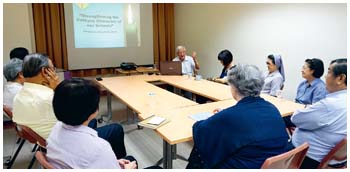
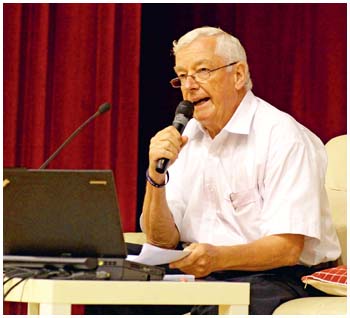
In his short meetings with school supervisors, school management committee members, chaplains and parent volunteers, Jesuit Fr Christopher Gleeson emphasised the need for faith formation.

Just as people have personal trainers for the body, there needs to be “personal training for the soul”, he stressed.

“The riches of our Catholic faith lie in our spiritual tradition,” he added.

During his 17 March session with school chaplaincy teams and parent volunteers, he shared about potential resources that Catholic schools here could use for the faith formation of teachers and students.

He also spoke about how students at one of the Jesuit schools in Australia went through a series of formation sessions in order to become Eucharistic ministers, a role that the students took seriously.

Meeting with school supervisors, school management committee chairmen and principals on March 18, he reiterated the need to tell the stories of schools’ Religious founders, pointing once again to the Emmaus story as a model of accompaniment.

Encouraging school board retreats, he said, “One’s own depth of spirituality as a school governor is a crucial element in the Catholic life of a school.”

Stated Fr Gleeson, “Never underestimate the power of the Catholic tradition or the congregational story as a lens on the Gospel,” adding that Christian communities that are not Catholic do not have the powerhouse that Catholics have because of their Religious traditions.

Ms Leslie Goonting, a parent volunteer said of the session, “I think we are empowered a bit more to know about what is happening in Australia. We have an idea of what’s available here and where the gaps are.” She hopes that “Catholic school leaders will more strongly embrace and prioritise the need for spiritual formation of the children and youth they serve and to also introduce all teachers and staff to what Catholic education is and form them accordingly.


By Mel Diamse-Lee, Catholic News.
Source: Catholic News, April 5, 2015, Volume 65, Number 07

5 April 2015

|

Tags: Educators

|

Categories: Events, Homilies / Messages

At the 2015 Catholic Education Conference, Archbishop Goh and Jesuit priest exhorted educators to point to the source of Catholic values and talk about the stories of their Religious founders. Catholic News reporter Mel Diamse-Lee sat in.


Archbishop William Goh challenged educators to speak of the source of values, Christ, to their students during teachable moments.

The impassioned homily of Archbishop William Goh rang out throughout the packed auditorium of St Gabriel Secondary School on March 16 as he encouraged teachers to talk about Catholic values to their students and point to Christ as the source of these values.

“A Catholic school that does not proclaim Christ explicitly at the end of the day, I don’t think is a Catholic school,” Archbishop Goh told some 400 Catholic educators, parents, members of school management committees and Religious Brothers and Sisters attending the Catholic Education Conference organised by the Archdiocesan Commission for Catholic Schools (ACCS).

At the Mass prior to the conference, he said that with the world changing rapidly as a result of technology, science and mass communication, “traditional values that we hold so strongly and steadfastly are being eroded away”.

Noting that “all our Catholic schools started with strong moral and religious values,” he added that “perhaps the current generation of leaders that we have … benefitted from our Christian Catholic education”.

However, because of secularisation and the negative effects of relativism, individualism and consumerism, these values are being challenged.

“What distinguishes us from non-Christian schools? Our values ultimately, are not simply ethical values, no, they are the values founded in Christ. Christ is the centre of all we do. When we give them [students] values but don’t give them the source of the values, we shortchange them. It’s like giving fish to people but we don’t teach them how to fish.”

Addressing teachers in the audience, he said, “As educators, you are to form minds. Your task is to give life. More than the physical and material, your task is to give the fullness of life … Ask yourselves, ‘Are we sincere in giving [students] a fuller life?’ ”

The archbishop also noted the four major challenges facing Catholic schools today: the dwindling population of Catholic students, the declining presence of Religious, whom he called “icons of the sacred”, from their schools; the role of the Ministry of Education (MOE) as the main payer and policy maker; and the autonomous way Catholic schools are run, being sponsored by various Religious congregations.

Keynote speaker, Jesuit Fr Christopher Gleeson, emphasised that telling stories, like Jesus did with parables, reinforces the Catholic identity of schools.

Character of Catholic schools

Picking up from where Archbishop Goh left off, Fr Gleeson gave the conference participants an opportunity to reflect on the theme of the conference, The Character of Catholic Schools. He put together a slide presentation with through-provoking quotations.

An educator for 21 years, he based his morning talk on the Vatican’s 2014 document, Educating Today and Tomorrow – A Renewing Passion.

Storytelling is a powerful way of transmitting the character of Catholic schools, Fr Gleeson said.

“Good storytelling builds on the experience of one’s listeners. The parables, which Jesus told, are ‘springboard stories’ leading people to discover the answers for themselves.”

From the Vatican document, he quoted: “Teachers are called upon to rise up to a major educational challenge, which is the recognition, respect and enhancement of diversity.”

He also spoke about “sacramental vision”, of finding God in all things, and being found by God in all things. “The test of our education is if we are able to produce people of discernment.”

Fr Gleeson’s afternoon talk focused on the character of a teacher, picking out the walk to Emmaus (Luke 24:13-35) as a model for teaching.

Pedagogy is about accompaniment, Fr Gleeson said. In the Gospel where Jesus met two discouraged disciples leaving Jerusalem, Jesus models the six “best elements of companionship”: walking with others, listening to their heart, telling a story, disposing (not imposing) blessing, and setting hearts on fire.

“True education is about transformation, and all teachers are, or should be, important figures in the lives of their students,” he said.

During the breakout session, where participants were grouped according to school levels, four questions were posed based on the sharing of Fr Gleeson on the key characteristics of Catholic schools that are successfully nurtured, challenges of operationalising what has been discussed, and which of the challenges participants would want to take up to help Catholic schools realise their Catholic identity.

Fr Edward Seah, acting executive director of ACCS, also gave an update on the seven key areas of improvement identified at the ACCS conference in September 2013. Among these were the creation of a directory of Catholic educators, school chaplaincy teams, greater laity involvement, formation and induction of principals and vice principals, and implementation of a Catholic ethos self-assessment framework and a Civics and Moral Education/Religious Education curriculum.

Feedback

Participants at the conference felt encouraged and inspired by the homily and reflection points given.

Canossian Sr Margaret Goh, lead chaplain and supervisor of the four Canossian Schools and St Magdalene’s Kindergarten, said, “The conference was well thought through, especially with Fr Edward giving an update on what ACCS has accomplished in the key areas for improvement. I embrace the bishop’s challenge of evangelising in the sense that there is a need to point to the source of values. The [Catholic] schools can be avenues for evangelisation, without imposing.”

Mr Eugene Yeow, a Catholic Junior College teacher, said, “It was good for me to know that the good practices are there. The spiritual health of schools is not as bad as we are led to believe, although it could be better. Kerygma [ongoing formation] can be provided in order to deepen the faith [of teachers]… so the students get the best out of our own experience.

“The personal challenge would be the mindset of teachers, the tendency for Catholic teachers to be more quiet when it comes to evangelisation. The transformational step is to view why there is a need for it. It is so that the children can see the impact. On a school level, hopefully there would be a continued dialogue between Catholic schools management and MOE.”

Madam Elizabeth Dass, a teacher at the Canossian School (For the Hearing Impaired), felt that the conference was “something like bread, feeding us with information. It was an avenue for sharing with other teachers and sharing faith, opinions, experiences and frustrations. At the end of the day, we can always mention Jesus during teachable times. The conference inspired me to mention Jesus in a teachable way.”

Sr Delphine Kang, supervisor of Marymount Convent School, thought that the conference was “really very good. A lot of people were very excited, very inspired to be witnesses and sacraments in the school. It’s not new but it’s an awakening. It’s good now and again to be reminded.”

Parent volunteer, Ms Clare Leong, said, “I think the conference has been successful in getting the Catholic educators together to work towards a more united direction for all Catholic schools in Singapore. I really appreciated the opportunity to share and to exchange each school’s experiences, ideas and practices.


Source: Catholic News, April 5, 2015, Volume 65, Number 07

3 February 2015

|

Tags: Educators

|

Categories: Events

In a multi-cultural, technologically advanced and increasingly globalised Singaporean society today, what role does the Catholic school play and how do you define its Catholic character? To continue empowering leaders and staff of Catholic schools in Singapore, the Archdiocesan Commission for Catholic Schools (ACCS) and the second Catholic Education Conference (CEC) organising committee have chosen “Character of Catholic Schools” as the theme for this year’s CEC, which will be held on 16 March, 8am to 5pm, at St Gabriel’s Secondary School.

This year’s edition of the biennial conference hopes to affirm and encourage all staff, both Catholic and non-Catholic, in their calling by providing a better understanding of what it means to be a Catholic school, as well as their roles in nurturing a Catholic ethos in Catholic educational institutes.

The conference this year will feature a full day of compelling discussion sessions and insightful talks by keynote speaker, Fr Christopher Gleeson SJ, a Melbourne-based Provincial Delegate for Education and Mission Formation.

About Fr Christopher Gleeson

Ordained in 1975, Fr Gleeson has spent most of his working life serving in Jesuit schools, nearly 21 years of which as Head of both Xavier College in Melbourne, and St Ignatius’ College, Riverview, in Sydney.

Between 1999 and 2010, Fr Gleeson served as Chair of the Association of Heads of Independent Schools of Australia, then Director of Jesuit Publications (now Jesuit Communications) in Melbourne, and subsequently inaugural Director of both the Faber Centre of Ignatian Spirituality, and the Archdiocesan Santa Teresa Spirituality Centre in Brisbane, before taking on his current role in 2011.

The experienced Fr Gleeson has even written a number of books for parents and teachers, and is the editor of Madonna Magazine.

“We are blessed to have Fr Gleeson at this year’s conference. He has a wealth of experience in leading schools through their formation to build a Catholic character,” relates Stephen Chin, Chairman of the CEC organising committee.

Education, A Renewing Passion

For his first session, Fr Gleeson had chosen the Vatican document, “Educating Today and Tomorrow – A Renewing Passion”, as the focus point. “It mirrors well the open leadership of the Church provided by Pope Francis, and outlines clearly in a non-defensive manner, the various challenges facing our Catholic schools and universities today,” he explained.

In this session, participants will get a look into what the Church teaches about the Catholic school, and how is it possible to develop the richness of the Catholic tradition in contrast to a merely functional view of education. The document, for instance, calls on teachers to help students “develop a multiplicity of skills that enrich the human person, such as creativity, imagination, the ability to take on responsibilities, to love the world, to cherish justice and compassion.”

The afternoon session will feature another keynote by Fr Gleeson, followed by an opportunity for participants to discuss what is happening in Catholic schools, as well as share with each other what are some ways to help develop a Catholic ethos.

Building on the first

As the planning direction for CEC 2015 had been based on responses and suggestions of the first CEC in 2013, participants this year can expect sessions to build on last year’s theme and reflect on a wider perspective, while only having to commit one day for this year’s conference, instead of two.

The focus of the 2013 conference was on how individual Catholic educators can be Gospel witnesses in their schools. This year, the conference will bring participants to reflect on the bigger picture – the character of a Catholic school, and provide a platform for educators to share ways to nurture a stronger Catholic ethos in these institutes.

Stephen reveals, “This year’s organising committee felt moved to focus on the people that matter most to any school culture and student development: the teachers. Hence, we designed this year’s conference to focus on faith formation of the teachers who will be leading in shaping the culture of our Catholic schools.”

Fr Gleeson affirms that, “Conferences of this kind are important events for confirming teachers in their vocation and giving them fresh ways of viewing their role.” He has often expressed concern where teachers may doubt their profession, regularly quoting Jonathan Sacks, Chief Rabbi of the Commonwealth, that “civilisations that honour teachers survive and flourish.”

Fr Edward Seah, Director ad interim at ACCS adds on, “We need to continue our dialogue and reflection with regard to Catholic Education in Singapore. They provide opportunities to share best practices and celebrate our strengths, and are avenues to encourage us to work together and inspire one another in our mission of providing Catholic Education here in Singapore.”

2 February 2015

|

Tags: Educators

|

Categories: Events, Homilies / Messages

Four new principals of Catholic schools in Singapore were commissioned by Archbishop William Goh on Saturday, 24 January 2015, in a special commissioning mass organised by the Archdiocesan Commission for Catholic Schools (ACCS).

The new principals are Mr Wilbur Wong, Montfort Junior School; Mr Mark Gerard Minjoot, Montfort Secondary School, Mdm Soh Lai Leng, Catholic High School; and Mr Kevin Hannah, SJI International Elementary School.

More than a hundred family members, friends, educators, colleagues, students and fellow principals attended the mass, held at the chapel of St Joseph Institution International.

Children of God

In his homily, Archbishop William pointed out that all three readings of the day coincidentally speaks about a vocation in life. He reminded those present that every human person ultimately “has a vocation to be a child of God, who share in the life and love of God.”

Citing examples from the three readings, Archbishop William affirms that, “at the end of the day, everybody who is called to proclaim the good news, must be at the service of truth and love.” He further questions, “Isn’t education a pursuit of truth and love?”

He explains that a Catholic school provides beyond simply an academic formation, but also human, moral, psychological, and most importantly, spiritual formation, pointing out that, “This is what makes a person human. Because every human person who has a soul, is seeking for God ultimately. In every person, the heart is restless.”

The principal and bishop

After reminding educators that every student is called to be a child of God, and the holistic approach of a Catholic education, Archbishop addressed the principals directly, “My dear principals, although your ultimate target, your audience, is your students, your immediate target is in fact your teachers and those who work directly under you. It’s like being a bishop actually.”

He elaborates further, “As a bishop, my audience is the entire people of God. But I can’t reach out to every single person in my life! Yes I preach to big crowds, I make appearances, but I cannot journey with everyone personally. So who will be my mouthpiece? My priests. Therefore it is the duty of the bishop to ensure that his priests are formed, and his priests are aligned to the mission of the church.”

Building on this point, Archbishop William hopes that principals, Catholic educators, and those working in Catholic schools, may continue to build their faith and hold onto Catholic principles, “because we cannot give what we do not have.”

Archbishop William concludes his homily by empowering those working in Catholic schools, that they should not be afraid to teach and guide students according to Christian values, because “the very fact that parents have chosen to send their child to a Catholic school, means they are saying ‘this is a good place for my child’.”

At the end of the homily, all principals and vice-principals present were invited to recite a prayer of commitment, and received a blessing from the Archbishop.

Past experiences

Mr Wilbur Wong, Montfort Junior School, was previously the Deputy Director for the Engagement & Research Division at the Ministry of Education, and before that he was principal of Telok Kurau Primary from 2005 to 2013.

Some key priorities he sees in his role as principal are, “to understand the needs of my students, staff and parents and continue to build on the good work of my predecessors. To ensure that Montfort Junior School continues in the tradition of St Louis Marie de Montfort and develop each Montfortian to be a ‘Man for Others’.”

Mr Mark Gerard Minjoot, Montfort Secondary School, was previously the principal of Greendale Secondary School from 2008 to 2014, and before that a vice-principal at Victoria School, as well as Deyi Secondary School.

Mdm Soh Lai Leng, Catholic High School, was previously principal of Holy Innocent’s High School for six years, and before that she was vice-principal at Marsiling Secondary School, as well as Naval Base Secondary School.

“I am happy to be back in the Catholic school family, and also excited because this new role is different and interesting. It will be a totally different environment for me, because this is an all-boy’s school as well as both primary and secondary levels,” Mdm Soh describes.

Mr Kevin Hannah, SJI International Elementary School, is Australian and has worked in Perth, Jakarta, London, Kuala Lumpur, and most recently, was Head of Junior School at All Hallows School in Somerset, UK.

Mr Hannah, who has been working in Catholic schools for most of his career, describes, “Once I committed to becoming a teacher there was never any doubt that I would end up in Catholic education. An education system that is underpinned by the Gospels, that emphasises the uniqueness of every child and with a pastoral system based on forgiveness resonates with me.”


28 January 2015

|

Tags: Educators

|

Categories: Homilies / Messages

By Archbishop William Goh


All three readings of this Sunday’s reading focuses on the call, a vocation in life. Every one of us is called to a particular purpose in life. In the first reading, we have Jonas who was called to preach to the Ninevites to repent and save them from disaster. In the gospel, we have Jesus who began his mission to proclaim the good news, and we have the call of the two apostles who left everything to follow the Lord Jesus. St Paul also speaks about a call. This vocation that St Paul speaks about, is not simply a vocation here on earth, but a vocation for eternity. That is why he says, “I say this because the world we know is passing away.” Our ultimate vocation in life is really to be a child of God, who share in the life and love of God. That is the ultimate vocation of everyone.

My brothers and sisters, as we come here this afternoon in this mass dedicated to principals, especially as Catholic educators, it is important for us to reflect on the vocation of the Catholic principal. This is the appropriate occasion to reflect on what the Lord is asking us to do, in order to fulfil our vocation in life. Indeed my dear brothers and sisters, we will never be truly happy in life, unless we live our vocation to the fullest.

In today’s gospel we have Jesus who began His mission to proclaim the good news and He said, “The time has come and the kingdom of God is close at hand. Repent, and believe in the good news.” How did Jesus proclaim the good news of the kingdom? Principally by teaching, by formation, and most of all, in the service of love. We know that the life of Jesus was dedicated to the healing and restoration of humanity. He wants to restore every one of us to the dignity of sons and daughters of God. So one way to proclaim the good news is to be in the service of love.

The other way to proclaim the good news, as we have read in the first reading of Jonah, is to be at the service of truth. It was not easy for Jonah to go to a pagan land and speak to the Ninevites, who were uninterested, and to ask them to repent or else they might face the consequences of their actions.

And so my dear brothers and sisters, what then is the role of the principal? At the end of the day, everybody who is called to be proclaim the good news, must be at the service of truth and love. So the challenges of a Catholic principals are really great. You know it is daunting enough to be a principal, but to be a Catholic principal, is even more daunting. And suppose you are a principal who happen to be teaching in a Catholic school, that is doubly daunting.

And why do I say this? If we want to be at the service of truth and love, then it presupposes that we are clear of what we intend to do for our children. Our young people here, what do we expect for them? What is our hope for these young people that the Lord has entrusted to us? Our hope is that they will believe in truth and in love. For them, it’s more than just simply offering them an academic formation. Academic formation is only a tool for something else.

A Catholic school has to provide beyond academic formation – a holistic formation, in terms of human, moral, psychological, and most importantly, spiritual formation. This is what makes the person human. Because every person is not simply a man, but every human person who has a soul, is seeking for God ultimately. Whether he or she recognises God or not, that is secondary.

The point is that in every human person, the heart is restless. The fact that the heart is restless, means they are seeking for the ultimate provider. That is why no one can be satisfied simply with material success. Even if you provide our young people with the best education, they can do very well academically, but there is no guarantee of happiness. Because happiness ultimately, is when we begin to see that our lives is not we for ourselves. That the skills we acquire is meant for the service of truth and love, for God, for humanity.

Anyone who studies for himself alone will never go far. In fact, he becomes a source of inhibition to society. Because he is individualistic, materialistic, he only works for himself. This is our concern for our children, our young people, the future of humanity. Otherwise we will face the same consequence of the Ninevites.

My dear principals, although your ultimate target, your audience, is your students, your immediate target, will not be your students. It will be your teachers, those who work directly under you. So principals, actually you must have two eyes, one eye to look at the future, how the students are being formed, the other eye, you have to look how the teachers are forming the students. It’s like the bishop. Actually the bishop and principal are the same.

Why do I say this? Because for me as a bishop, who is my audience? My audience is the entire people of God. But I can’t reach out to every single person in my life. Yes I make appearances, I preach to big crowds, but I cannot journey with everyone individually. So who will be my mouthpiece? My priests. So the most important group of people for the bishop will be his priests, although my goal is to serve the people. Because my priests have a direct impact to them, it is the duty of the bishop to ensure that his priests are formed, that his priests are aligned to the mission of the Church.

Similarly principals, you cannot reach out to every student. Your teachers have direct control over them. The truth is this, formation is not purely academic. Even in an academic lesson, when you start citing examples, I am sure the teacher would directly, or indirectly, convey his or her values of life.

You know when we speak of Catholic education, we are not fragmenting education – oh now its biology, now its geography, now its scripture lesson. Catholic education is not a matter of subjects. Catholic education is that the whole curriculum, all its values, are motivated by Christian principles.

Therefore I say, your immediate care must be for your teachers. Because if your teachers are not aligned with your vision and mission, and with the values of the schools, in this sense with the values of the Catholic faith, then how are they going to provide a Catholic education?

My dear educators, if truth cannot be found, then what are we doing? Isn’t education a pursuit of truth and love? And that is why for us Christians, the Catholic teaching is real. Truth and love ultimately can only be found in God. Christ for us is the fullness of truth and love. That is what the responsorial psalm says, “teach me your paths, guide me in your truth, for you are my God, my saviour”.

So the principal will have to ask himself or herself, how can we deepen our faith? Even if you are not a Catholic. If you are not a Catholic teaching in a Catholic school, I empathize with you. Because how are you going to imbibe in the values, especially when it concerns Catholic teaching. How are you going to promote a Catholic spirituality, when actually, yes perhaps you embrace it and accept it, but it is not from your heart? That is a real challenge. It is already difficult enough for many of our Catholic principals. Because not all our Catholic principals are praying every day, reading the word of God. But I hope they are! I presume that all Catholic principals are so convinced in their faith and that is why they are interested in Catholic education.

Many of our protestant Christian schools are highly respected, and many people want to enter those schools. Because people see the values that these schools uphold in terms of faith and morals. Even more than Catholics, protestant Christian parents want their children to go through such schools.

I think it is important for us to raise the standard of Catholic education in our schools. Our schools must be truly Catholic, in the fullest sense of the word. We have to ensure that education is Catholic, motivated by Catholic principles. Otherwise, I don’t see why we call ourselves Catholic schools.

Of course, in the process of imparting our faith, and we have always said, there is no way others would feel threatened, because we never proselytise. But faith has to be proclaimed! Faith has to be shared. Otherwise, they will not know the fullness of life and fullness of truth. That is why as educators, we should not only want our students to pass their exams, but also to be happy in life here on Earth. From that perspective, this is where Catholic principals, you will have to really acquire and understand the faith. We cannot teach what we have not been taught. And we want to give only the best.

I believe, my brothers and sisters, that if people send their children to a Catholic school, even if they are not Christian, the fact that they send, they are implicitly saying “my children will be for you”. If they had so much against the Catholic faith, then they would ensure their children goes to another school, in case they get indoctrinated. But the truth is, many people are happy and appreciative of the Catholic values that we impart to our young people. And therefore we should not feel defeated, but rather feel courageous, that this is what they want.

Teaching is more than just a mundane thing. In the gospel today, we have the disciples casting out nets and mending their nets, and these are mundane things people do everyday. But as teachers and principals, we may be doing the same thing everyday, but it is not mundane. That is to say, we have to be clear of our vision and mission. We have to be clear of what we want to do and how we want to help people. For me, life is really worth living, it not just going through the chores. Teachers can just go through the chores too, they can just teach, just do their work. But these kinds of teachers will not bring us far. Same for students, if you just study for the sake of studying, you won’t go far. You study because you have a mission, because there is a mission waiting for you, because there are many people waiting for you. We want to change the world, we want to empower lives, and we want to make a difference in society. Then our studies become focused, and our work becomes empowered.

And so my dear brothers and sisters, I finish by saying this. Jesus said to Andrew and peter, “Follow me, and I will make you fishers of men.” Will you allow Jesus to catch you? Before you can catch others, we need to be caught by Jesus. If Jesus has not yet caught you, then you have not fallen in love with Him. If you have not fallen in love with Him, then you will lack power in your mission.