They Are God’s Children By Donna Koh
In school, major and difficult decisions often come down to the answer to this question:
“What if this were your child?” Multiple opinions are offered in response, and I am struck
by how everyone makes a concerted effort to consider the “best interest” of the child.
Yet I often wonder about the way this question is naturally exclusive; it implies that
wearing the parent hat leads to the best decisions for the child, that the educator’s hat
is not as good. Even worse when teachers make the conciliatory disclaimer of
“I am not a parent, so…”, as if implying that the opinion and decision may not be as
thoughtful, or well-intentioned.
“best” means? What if we accepted that we all want the absolute best for young people,
and this necessitates a common vision and mission?I think this starts with understanding that children are not ours to influence at will,
nor are they even ours to begin with; they are God’s children. Shaped by learned
experience of how one can survive and succeed in a specific context or society,
adults recite tips, adages and cautionary tales to steer young people in the direction
we deem necessary, safe, best.
Affected by personal circumstances, relationships, wounds, we transfer our own
worldview and impressions to the young. What a huge undertaking it is to have young
people in our care; but also, what an enormous privilege it is to be called to this ministry
(in more ways than one) of educating, and be able to share who and what we are with
the young people we encounter.
Most importantly, we are called to share who God is with our young people, how He
sees and loves His children, and how they can make the world a little more like the
one Christ came to build.
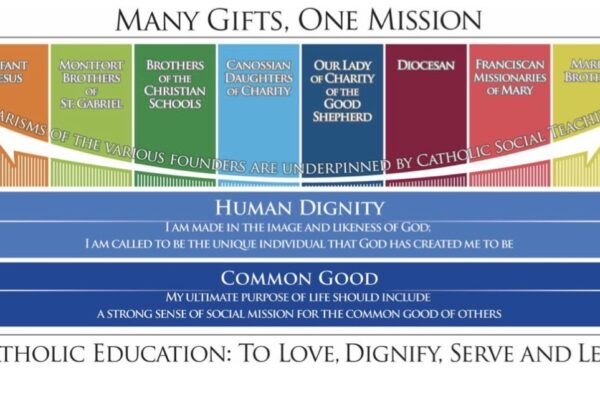
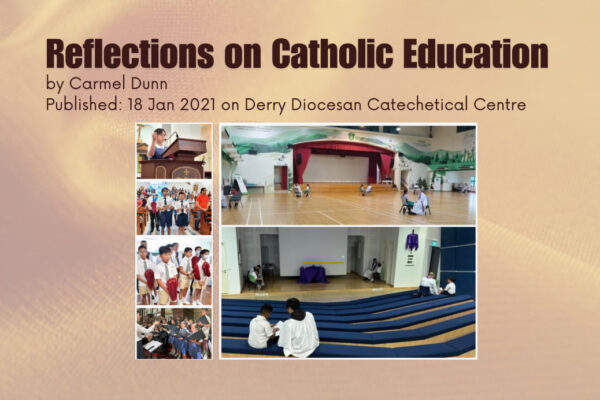
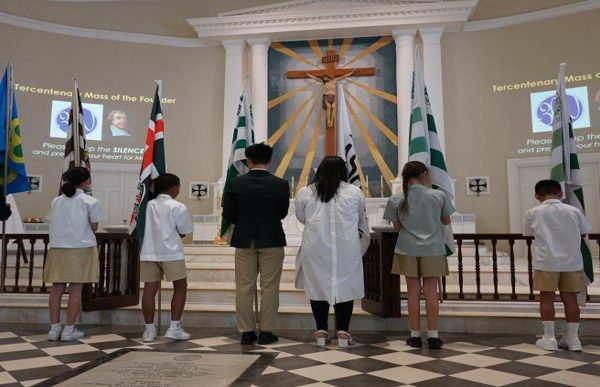
Catholic schools are special. While curriculum – apart from Religious Education –
is secular, the school culture is imbued with a Catholic ethos. And what does that
look like?
It means respecting every child’s dignity by accepting their uniqueness as a human
being who is a work in progress; forming them as a whole human person by showing
them how to serve and not just to achieve, and how to flourish and not just to survive.
It means encouraging them to pursue, and honour, their God-given gifts and talents
even if these are not money-making endeavours.
And it is honestly not enough for schools and parents to believe and practice this
separately. When we echo the same sentiments – not what we each desire as a separate
entity, but what God desires – the whole village educates the child together, united in
vision and mission.
Almost a decade ago, students from my Secondary Four Literature class gave me two
onions for my Teacher’s Day gift. They were referencing the poem Valentine by
Carol Ann Duffy that we had analysed in class together, in which the speaker presents
an onion to her partner as a Valentine’s Day gift.
We had discussed the complexity, ugliness and pain of authentic, raw love,
juxtaposed against the romantic, materialistic, showy love that society has conditioned
us to desire. We talked about the examples of ‘onion love’ we know in real life;
friendship and its patient steadiness as well as marriage and its commitment through
perseverance came up, as did sacrifice and unconditional love through Christ’s
crucifixion.
Handwritten notes aside, I have never treasured a Teacher’s Day gift more, and only
wish I could have preserved the two vegetables; I was so heartened by how sensible
my students were, and hopeful that they will continue to be exposed to, and practise,
love that is life-giving.
(Two onions, from Teacher’s Day in 2017)
Life-giving love is exceptionally challenging when the pace of life is fast, vulnerability
is contained, and efficiency goals put human-centricity on the back burner. But if our
agendas were more God-centred, and focused on what we know is timeless and
enduring, imagine the ways our young people would flourish!
During one of my recent (and frequent) angst-ridden rants about people’s
overreliance on Artificial Intelligence and its ‘productivity-enhancing’ benefits,
someone suggested that I “quietly throw sand in the gears” and never have I ever felt
more inspired to start a revolution, the kind where I say things like:
Stop for a moment. How does God see this world and His creation?
What ought we to do in this situation?
Shall we consider at what cost and to whose detriment this is?
Who did God make you to be?
What can you do for God and His people?
And I wonder what would happen if we all came together to do the same. Boldly.