8 September 2015

|

Tags: Educators

|

Categories: Reflections, Saints

Why is the birthday of our Lady so special, and what can educators learn from this special event?


In a single liturgical year in the Catholic Church, there are feasts for nearly every aspect of Mary’s life; her Queenship, her Immaculate Heart, her Assumption, the Annunciation, the Visitation, the Immaculate Conception. And on 8 September, the Church once again commemorates the Nativity of the Blessed Virgin Mary.

But what makes the earthly birthday of the Blessed Virgin so special? In fact, there are only three persons whose birthdays are commemorated in the Catholic Church; St John the Baptist, Mother Mary, and Jesus Christ.

While there are many reasons to commemorate Mary’s birthday, each stemming from Sacred Scripture and Tradition, there may perhaps be one simple, yet endearing significance which educators might find helpful.

Temple of the Lord
The Nativity of the Blessed Virgin was the day that God had constructed His temple; the day on which a creature became the preferred dwelling place of God. In remembering her, we remember that God, in His grace, mystery, and love, has chosen to concern Himself with mankind so intimately as to “come to them and make our home with them” (John 14:23).

A reflection on the birth of Mary pulls the mystery and wonder of God’s love into focus. How is it that this indescribable God of all creation, has not only chosen a little girl to be His temple, but also chose to become incarnate through her, “so that everyone who believes in Him may not perish but may have eternal life” (John 3:16). It is such an understanding of God—a God who is so intimately concerned with mankind—that forms the distinguishing mark of the Christian faith.

Commemorating the Nativity of Mary leads us to ponder on the divine nature of Jesus Christ, and in pondering His divinity, we come to acknowledge the immensity and humility of God’s love that is offered to every person.

While Blessed Mary had the special privilege to be the temple of the Lord both physically and spiritually, we are reminded that God also calls everyone to the same grace of being the dwelling place of God.

St John affirms in his letters to the early Church, “By this we know that we abide in Him and He in us, because he has given us of his Spirit” (1 John 4:13). On another occasion, St Paul tells the Corinthians, “we are the temple of the living God; as God said, ‘I will live in them and walk among them, and I will be their God, and they shall be my people’.” (2 Cor 6:16).

Beloved children
For educators, reflecting on this special importance of the Nativity of our Mother helps to put into perspective that truly, every student is a precious child of God, a temple of the Holy Spirit. There is a holy and immense love that exists between every child and their Creator, and educators share in the sacred duty of helping them discover this.

When birthdays are celebrated, we celebrate the gift of a person, the life that he or she has, and the joy that they have brought to their loved ones. But as we celebrate the birthday of Mary, we discover that there is also a bigger reason we can rejoice—God’s dwells in this person.

In the Catholic devotion to Mary, we see that it is because of God that she is remembered, it is the grace of God that she was made holy. Her nativity is remembered because it is the dawn that points to the coming light of Christ. In a similar way, we see that every child is called to holiness in Christ, to be the light and salt of the earth. As we celebrate the earthly birthday of Blessed Mary, let us also celebrate the joy of our identity as the dwelling place of God, His chosen people.

28 August 2015

|

Tags: Educators

|

Categories: Reflections

Literally leaving everything behind, Sr Assunta Cheng left her hometown in Taiwan nearly seven years ago to serve with the Franciscan Missionaries of Mary (FMM) in Singapore. She shares her experience being involved as a spiritual counsellor in Holy Innocent’s High School and St Gabriel’s Primary.


What are some of the difficulties in your area of work with schools and education?
Different schools have different situations. But I think teenage students are more challenging, because they are more attracted by things outside than in religious and spiritual ways. Like when I prepare a spiritual session for students each week, only about eight to 10 good students will come on their own, and it’s always only the upper secondary students. The lower secondary ones don’t seem to care, they don’t like it, and so I have to approach them.

How do you overcome them?
Prayer, and I think the most important thing is to befriend them. Sometimes when I approach them, especially those lower secondary, I won’t question them hey why didn’t you come to see me or to see God, to see Jesus? I would instead ask, how are you? What is going on in life now? Or what did you eat during recess? And other questions like this. I try to befriend them, talk about their studies, their life, to try to understand them.

What do you like about working in the education sector?
Because I enjoy being with youth and young people, it’s very nice to be able to be with them the entire day. When you can get to know them, to know their difficulties. Even sometimes when they don’t see my role in their studies, and they keep a big distance from me, I think it’s good to have a chance to talk to students. I will take any opportunity to get to know students. For example I usually go to every class in the morning, about 7am. The principals are the ones who requested me to do this, the most important is that I represent the religious character of the school. Students of all religions, not just the Christians, will have a chance to talk to me this way.

Do you have any fondest memory of your time in the education sector?
A lot of interesting things has happened, but I’d like to talk about the secondary four students in particular. Actually for secondary students, they are more difficult to understand deeply. They only want to talk about their studies, or other surface issues. It’s a little tougher if you want to talk deeply with them.

I remember one or two years ago, there was a secondary four student passing by the chapel in the school. I was there doing some arrangements. I thought it was very strange that during school time this boy could still be walking up and down. So I thought oh, he must be having some trouble. He decided to come into the chapel after a while, and I tried to talk to him. Turns out, his teacher had just confiscated his handphone and he was very upset by it. So I said okay let’s sit down and talk about it. I asked him, you know it’s your fault, but you’re angry? He says yes. So I asked, when you were primary school, did you have a handphone? He said no. Were you happy then? Yes. Now you are at the secondary level, you have a handphone, but are you happy now? No I’m not. Now, is the handphone controlling you or are you controlling the handphone? You have a phone now, but you are unhappy when someone takes it away. Then why do you want to have one in the first place? You’ve become a slave of it. He just thanked me and left the chapel after the conversation, and I didn’t keep this in memory much. But on graduation day, this same boy approached me to thank me, and a few months ago, I bumped into him again on the road but I didn’t recognise him because I minister to so many students. But he remembers me, and I think these are some fond memories I have when I can talk to secondary level students on a deeper level.

What does being a Catholic educator mean to you?
To be able to pass onto them God’s love, to help them know that God loves them unconditionally. Also, for many students, they are struggling and are still in the growing process. They need encouragement, someone to show them direction. To me, the most important is to be able to show them God’s love, and being a teacher is a very good chance to do something like this.

What is one thing about the foundress of the Franciscan Missionaries of Mary that inspires you?
My foundress is Mary of the Passion. Her very open mind is what inspires me. She in fact came from France, but was sent to India to minister. She was able to have an open mind to recognise the differences between the races and their different needs. Especially since our Catholic Church has a universal mission. Even though she is in a different country surrounded by a different culture, she still tries to bring Christ to them. And the way she does this is very inspiring. I was touched by her wider vision, her universal vision.

Has a student ever inspired you or taught you something valuable?
There is quite a lot. I have actually learnt a lot more from students than I have taught them. I remember asking a primary school student once, what do you wish for in life? And he told me, I want to have love for my family. Immediately I was really touched, I told him I will pray for him. To see a primary school student who doesn’t wish for good grades, but instead wishes for love for his family, for something so deep, it really touched me.

How about a teacher? Does any particular experience still resonate within you?
In the schools I’ve met quite a lot of teachers who have served more than 40 years already. Even though they have been in this line of work for so long, you still see so much passion they have for students. Especially since students nowadays are getting more challenging to handle. There are times they even scold their teachers and try to chase them out of the classroom. It’s really not easy. But these teachers, and there’s not just one or two but a few of them, even though the students treat them this way, the next day they still come back and still care about their students. They are still willing to show them care and love.

What difference would it make if a parent (especially a Catholic parent) enrolled his children in a Catholic school?
Of course, they will have the opportunity in the Catholic school to bring their children closer to the faith. To buy bibles for them at the school bookshop, to be able to guide their children to trust God, and build up their faith. In Catholic schools, the difference is not only a religious moral education, but also many Catholic activities that tries to help students meet Christ.

What is one advice you would give to teachers today?
Never give up on any student. Even if they are very naughty or if they appear hopeless. I remember once, I went into a class to see a primary two boy chasing his classmates around the class with a stick. I stopped him and asked for it, but he refused and fought with me. So I said ok, now put the stick in the corner where I cannot reach it, but you have to put it there because I want to talk to you. I was just trying my luck but he really did it. Then I addressed the class, is this boy good or bad? They all shouted bad. But now I asked them, let’s talk about the good things about him. One student started sharing, oh sister he carried books for the teacher. Ok very good. Then another student started complaining he pinched others and pushed their chairs. Then this very boy said, “sister say only good things!”

So when I say never give up, this is what I meant. That there really is good in every student, and even he knows it himself; what is good and what is bad. He knows. As long as you have a chance to journey with them, then you have a chance to give them the right direction.

3 August 2015

|

Tags: Educators, Parents, Students

|

Categories: Events, News

Our Canossian schools — St Anthony’s Canossian Primary and Secondary, Canossa Convent Primary and the Canossian School for the hearing impaired — made up a 180-strong combined choir to perform in an interfaith concert celebrating SG50. They sang Let There Be Peace on Earth at the concert titled Harmony in Diversity, celebrating religious and racial Harmony in Singapore.

Held at The Star Vista in a crowd of about 5,000, the event was jointly organised by New Creation Church and Taoist Federation (Singapore). It brought together 10 of the major religions — including Buddhists and Bahai’s, Christians, Hindus and Muslims — and the four main races in Singapore in song and dance. Prime Minister Lee Hsien Loong was the guest of honour.

Harmony in Diversity Concert LHL

Deacon Matthew Kang, Chairman of New Creation Church, said, “As Singapore celebrates the 50th year of its independence, we give thanks for one of the most precious legacies that has been handed down to us – our racial and religious harmony. It is something worth celebrating and New Creation Church and Taoist Federation are happy and honoured to be co-organising this meaningful event.”

Mr Tan Thiam Lye, Chairman of Taoist Federation (Singapore), added, “We are very happy and encouraged that every race and religion represented in Singapore is involved in some way in tonight’s celebration event. Through this event, the relationships between the leaders of different faiths and races have been strengthened. This is a wonderful outcome.”

Sr Theresa Seow FDCC, Vice-Chairperson of the Archdiocesan Catholic Council for Interreligious Dialogue, and member of the event’s organising committee, shared her delight for the Catholic Church’s involvement in this interfaith event: “To see 180 children of our Catholic schools come together to perform was beautiful.”

She added: “The song performed by the choir was an appropriate one for the occassion, seeing that peace among different religions is what we’ve had in Singapore these 50 years. It is also our desire for future generations to have this peace, not just here in Singapore, but also in the world; it was symbolic that it is the children who sang that message.”

Harmony in Diversity Concert Canossian Choir 2


In spite of the logistical and administrative challenges of bringing so many schools together, the schools overcame the obstacles because “everyone was excited about participating in the event,” shared Ms Chua Lee Beng, HOD of CCA at St Anthony’s Canossian Primary School.

Recalling the performance, Ms Chua added: “I was watching the students sing on stage from the holding room backstage and I could not help but feel a sense of pride of the combined effort of the four schools, coming together as one Canossian family to share the message of peace with the different religions and races in Singapore. The reviews that I read on Facebook reaffirmed that their song touched those who attended the event that night.”

Apart from the performance put up by our Catholic schools, the concert also featured a drum performance by members from the Kong Meng San Phor Kark See Monastery, a solo Indian classical dance, and songs by a multiracial group of singers, and a special joint martial arts display by Wudang Sheng Hong Health Preservation Centre and Perguruan Sim Putih. The night ended with the recitation of the national pledge of Singapore, a fitting reminder that “we, the citizens of Singapore” are “one united people, regardless of race, language or religion”.

Harmony in Diversity Concert Pledge


More coverage by Channel NewsAsia, Catholic News.

31 July 2015

|

Tags: Educators

|

Categories: Reflections, Saints

How is it that the reflections and prayers of a man in a cave hundreds of years ago, continues to offer important and relevant lessons for educators today?


On 31 July each year, the Catholic Church commemorates the memorial of St Ignatius of Loyola, one of the most famous Saints of the Church. He is remembered most notably for writing his Spiritual Exercises, a set of meditation and prayers that continue to change the lives of many, and for establishing the Society of Jesus, which has today become the largest male religious order in the Catholic Church.

Amidst various ministries in social justice, parishes, and retreat centres around the world, the Society of Jesus are also particularly regarded for their work in education. St Ignatius’ Spiritual Exercises, composed between 1522 and 1524, had become the inspiration for a Jesuit teaching pedagogy that was not only immensely popular in the 15th century, but had also proved an incredible effectiveness throughout its 500 year history.

It is most interesting to note that Spiritual Exercises was developed during a time of personal solitude St Ignatius spent in a cave, before he was even a priest. As we commemorate the life of this great Saint, let us reflect, what can educators learn from the reflections of a man in a cave hundreds of years ago?

Spiritual Exercises
While there are indeed many lessons that can be drawn, one notable characteristic of an Ignatian-inspired education stands out—the view that education is not meant to simply “amass a store of information or preparation for a profession, though these are important. The ultimate aim is, rather, that full growth of the person which leads to action, action that is suffused with the spirit and presence of Jesus Christ,” explains the immediate past Father General of the Jesuits, Fr Peter Hans Kolvenbach SJ.

Observing the structure St Ignatius had written his Spiritual Exercises, coupled with the fact that it is intended to be a guide for spiritual directors, the book becomes a helpful portrayal of the ideal teaching-learning process, and the ideal teacher-student relationship.

The Exercises were carefully put together based on St Ignatius’ own prayer experiences in the cave, where he practiced not merely cognitive activities or devotional practices. They are, instead, rigorous exercises of the spirit wholly engaging the body, mind, heart and soul of the human person.

These exercises, such as contemplating the gospels, or examining one’s own conscience, are practices which St Ignatius believed helps a human person to reflect on the experiences of his or her life, and thus be able to direct future actions toward God instead of sin.

St Ignatius urges reflection on human experience, seeing it as an “essential means of validating authenticity, because without prudent reflection, delusion readily becomes possible and without careful reflection, the significance of one’s experience may be neglected or trivialized,” describes a document published by the International Centre for Jesuit Education in Rome, Ignatian Pedagogy: A Practical Approach.

Experience, reflection, action
This emphasis placed on experience, reflection, and action, is thus translated into Ignatian education, where the teaching-learning process is encouraged to move beyond simply acquiring knowledge, but to also involve a reflection of new things learned, and an active application of them.

The International Centre for Jesuit Education in Rome argues, “If learning were to stop there, it would not be Ignatian. For it would lack the component of reflection wherein students are impelled to consider the human meaning and significance of what they study and to integrate that meaning as responsible learners who grow as persons of competence, conscience and compassion.”

Because reflection is such a pivotal instrument in the movement from experience to action, St Ignatius also makes it the primary responsibility of the spiritual director to facilitate the progress on reflection.

In turn, an Ignatian educational pedagogy also views the teacher’s primary responsibility as that of helping students reflect on the knowledge they receive, one whose job is not merely to inform but to help the student progress in the truth.

Jesuit schools
This unique style of education inspired by the prayers of St Ignatius has certainly proven itself to be effective and relevant. Despite a constantly changing society through the years, Jesuit educational institutes continue to spread and grow in numbers.

Within just 22 years of establishing the Society of Jesus in the 15th century, the Jesuits had numbered up to a thousand, with a good majority of them involved in 35 schools spread throughout Europe. For the next 25 years the number of schools swelled to 144, and in another short 35 years, this number approached 400. According to a 2014 report by the International Commission on the Apostolate of Jesuit Education, there are 2,129 Jesuit educational institutes around the world today.

On top of a rapid growth and expansion around the globe, Ignatian inspired education has also led to countless alumni who have each made a positive influence for mankind and society. Alumni of Jesuit schools include notable priests, religious, politicians, scientists, businessmen, engineers, and of course, even Saints, such as St Francis de Sales and St Robert Bellarmine, both of whom are regarded as Doctors of the Church.

As we remember St Ignatius and his inspiring pedagogy, let us also take some time to reflect on our own experiences, to allow the Spirit to enlighten and enrich our human lives, and thus be guided closer to Christ.

30 July 2015

|

Tags: Educators

|

Categories: Reflections

The main calling of the Marist brothers is education, and this was exactly where Br John Lek FMS has been serving God since taking his vows more than 50 years ago. He shares some of his experiences and lessons learnt over the years.


What are your roles and responsibilities as a religious involved in education?
I began as a teacher in a secondary school in Sibu, Sarawak. Besides teaching, I helped lead Catholic activities in the school as spiritual director of the Legion of Mary and with them promoted Catholic activities in school. Then, while still teaching, I took on various responsibilities such as work as laboratory technician, librarian, office clerical work and director in charge of the training of potential candidates for the Marist Brothers. Back in Singapore for a short time, I was teacher, discipline master, and then principal at Maris Stella High School. At another time, I was chosen to lead the Marist Brothers of our region comprising of China, Taiwan, Hong Kong, Malaysia and Singapore.


What are some of the difficulties in your area of work with schools and education?
Difficult students and teachers. The difficult students are easier to deal with than the difficult teachers, because teachers are adults and believe that their ways are right, their ways are the best and perhaps the only way. There is the clash of values, attitudes and ways of dealing with things.

It was not at all easy [to overcome these difficulties], the anger, the anguish and the disappointments. But it is during such moments that I experience the power of God, the action of the Holy Spirit, more concretely. I do my best in the way things should be done, and somehow, things turn out okay.


What the fondest memory of your time working in the education sector?
One of the instances that comes to mind was a student whom I managed to help persuading his parents to let him switch school. He came and thanked me after a few months in his new school, and told me that he had become a student leader. He had been causing trouble and after many hours of talking with him, I came to understand his aspirations and decided to help. This was one of the occasions I really experienced what it means to listen with an understanding heart.


What does being a Catholic educator mean to you?
God is love and He loves us unconditionally, which is well manifested in Christ Jesus. As Catholic teachers we are to transmit that. Our founder, St Marcellin Champagnat, famously said, “I cannot see a child without wanting to let him know how much Jesus Christ loves him and how much he should, in return, love the divine Saviour”. He founded the congregation in order to “make Jesus and Mary known and loved”. This is one of the things that differentiates a Catholic teacher from any other teacher. However, God gives us freedom to respond to His love and He accepts us the way we are. We accept everyone irrespective of faith, race and culture. We share our belief and values by words and deeds. We do not impose our faith on others.


Why is education an important aspect of the Marist brothers?
Education for the young, especially those most neglected, is what we are founded for. Our founder, due to his personal experience of the deprivation of education, particularly Christian education, was convinced that that was what he was called to do. With the consent of his Marist Fathers, he founded the congregation barely six months after his ordination.


What is one thing about St Marcellin Champagnat that inspires you?
That his personal experience of the neglected youth in the aftermath of the French Revolution was able to move him to start a congregation to provide Christian education for them. He was a man of action, a man of vision, a man with an understanding heart, a humble character who treated everyone as equals. He was ever present to all, always available, and he formed his Brothers to do the same.


Has a student ever inspired you or taught you something valuable?
I spent many hours talking to a student who had been causing trouble to teachers and his parents. I discovered he was so intelligent that he was able to see through me and the methods I tried using to deal with him. He knew every psychological term and strategy. I learned not to talk down to people, no matter whether they are younger or under my charge. I try to be aware of what I am doing when dealing with people, as much as I can.


Any such experience with teachers you’ve worked with?
One colleague that I admired was a teacher who chose to be the form teacher of the more challenging class, instead of the brightest ones. She would treat the students with respect and encouraged and challenged them to do their best, affirming them at the appropriate time and in creative ways.

On the other hand, encountering a negative example had also taught me a valuable lesson. I knew a teacher who had an overly high expectation of her students, resulting in her unintentionally hurting a student who had difficulty coping with school after he lost his father. He had to repeat a year as he was unable to deliver, and the teacher unknowingly said things that he found hurtful. I had much trouble trying to counsel him and encourage him after that. I learned from that incident that teachers should really try to have an understanding heart, to be open and non-judgmental when trying to find the root cause of problems.


What is one aspect or character of a Catholic school that you appreciate the most?
Catholic schools in Singapore are able to provide faith formation for Catholic students and students who are interested. Catholic schools are also able to instill spiritual values to all. We share with our students the Catholic values and world view, but we do not impose anything on them.


What difference would it make if a parent (especially a Catholic parent) enrolled his children in a Catholic school?
In general, Catholic schools in Singapore has sound ethos and strive to provide a holistic education and spiritual values, preparing students to be a good and compassionate persons and citizens. Another important aspect you can find in a Catholic school is faith education.


What is one advice you would give to teachers today?
Be open-minded, be positive, be patient and compassionate in dealing with every situation you encounter. Be aware of your personal agenda and try to be other-centred. Do your best and leave everything to God. One of the favourite prayers of our founder, St Champagnat, is psalm 127, “If the Lord does not build the house, in vain do its builders labour; if the Lord does not watch over the city, in vain does the watchman keep vigil”. Be patient, God has His time and His way of achieving the best. Things will turn out better than what you expect or the way you think it should be. Look back at your life and if you reflect deep enough, you will find that this has always been true. Have faith in God.

22 July 2015

|

Tags: Educators, Students

|

Categories: Events, News

Over a hundred students and teachers from Catholic schools were involved in special performances at the recent SG50 Thanksgiving Mass. They share how in their participation, they have discovered the beauty of being a Catholic School.


The recent SG50 Thanksgiving Mass that took place at the Singapore Indoor Stadium has certainly helped put Catholic education in Singapore back in the limelight, leaving many with a deep sense of pride and hope. Not only was the Church’s history and contributions to the nation’s education sector commemorated, but special performances were also prepared by more than a hundred students and teachers from Catholic schools here.

CHIJ Kellock Primary School’s choir sang uplifting hymns and harmonised with the 60-member full orchestra, while both St Anthony’s Canossian Primary and Secondary Schools’ percussion groups worked together to drum up an energetic performance with a diverse number of instruments.

JoySG50 School CHIJ Kellock Performing You Are Mine 1

In the challenging process of putting everything together within just a couple months of practice, teachers and students of the participating schools share that they have come to truly see the beauty of being a Catholic school.

JoySG50 School CHIJ Kellock Lunch Time

School, Church, Nation
Though the relationship between Church and School can admittedly be blurred at times, it is events like the SG50 Mass that helps students come to a deeper appreciation of their schools’ connection with the Catholic Church. They had not only learnt about the Church’s role in building up the education sector of Singapore, but were also given the chance to actively participate in celebrating the hopeful future of both Church and nation.

“The school and the choir were thrilled to be part of the JoySG50 performance team. Our principal reminded us that when the Church calls, we respond in faith and love. As part of the Catholic school community, we look forward to opportunities where we can share the good news of God’s love with those around us,” explained Mary Soh, Teacher Liaison for the CHIJ Kellock Primary Choir.

Because the choir consisted of non-Catholic students as well, the teachers of CHIJ Kellock Primary also paid special attention to help students understand and appreciate the hymns they sung. It was not simply a performance, but truly a thanksgiving occasion.

To the students who had lovingly volunteered their time, whether Catholic or not, their participation was important because of one common trait that unites themselves, the school, and the Church – being Singaporean.

JoySG50 School CHIJ Kellock with Prime Minister Lee Hsien Loong

Students echoed one another’s sentiments as Deborah Ann Lim, a choir member from CHIJ Kellock Primary expressed, “I am grateful to be given this once in a lifetime opportunity to perform at Singapore’s 50th birthday.” Jacynthe Liew and Steffi Chua, also choir members, chimed in, “Especially since PM Lee was also present to grace the occasion!”

The bigger picture
For the percussion groups of St Anthony’s Canossian Primary and Secondary Schools, performing at the SG50 Mass together as sister schools had also been a valuable lesson to see the bigger picture of their Catholic education.

JoySG50 School SAC 5

Veron Yap, Teacher Liaison for St Anthony’s Canossian Schools, shared, “It was an opportunity for the students to come together as sister-schools in close partnership to work for a common goal. It was a platform for students to challenge themselves and overcome what they perceive as their limitations, and they have proved themselves resilient and optimistic.”

JoySG50 School SAC 2

The schools’ willingness to participate in the occassion reflected the value of Catholic education, which is not only concerned about grades, but the development of the whole human person. Veron describes, “We believe that each student has an innate, God-given talent, and we just need to take the chance to help them discover it. These platforms are opportunities for students to be developed holistically.”

Overcoming limits
Because of the limited preparation time, which had been further hampered by the June Holidays, the St Anthony’s Canossian Primary and Secondary School percussion groups had to practice separately first, then subsequently combine their rhythms.

This proved challenging because the schools had different musical styles, and it was the first time they were collaborating with one another. However it was through these difficulties that teachers could help students see that they were in this together, and that God was in control.

“We committed everything to God and put in time to practice. Both schools were given time to interact so as to team-build and form warmer ties before the performance,” Veron illustrates.

JoySG50 School SAC 4

For the choir from CHIJ Kellock Primary School, teachers had also created learning tracks for the different voice parts and uploaded them onto the school’s online learning wall. This way, the disadvantage of the June holidays taking away practice time was minimised.

“Students were tasked to learn their melodic parts via this social medium, which has helped our choir to be more confident with their voice parts and to sing in beautiful harmony,” Mary expressed.

JoySG50 School CHIJ Kellock Group Photo

Organising chairman of the Church’s SG50 celebrations, Fr Derrick Yap OFM, highlights that it is important for the younger generation to feel proud of the Church, to understand that, “God has called us to be His children, and to belong to this beautiful Church.” Thus, he explains, “I tried to involve as many young as possible so that in days when they’re feeling down, hopefully something that was said, something that was sung, or someone that they met here, they remember it and they hold it in their hearts that God is real, for them at this moment.”

16 July 2015

|

Tags: Educators, Parents

|

Categories: Reflections, Saints

St Benedict was young, wealthy, and healthy at the time he decided to step back away from the world to pursue what he thought mattered most. Do parents and teachers value the same things today?


On 11 July, the Church commemorated the life of St Benedict of Nursia, one of the most well-known and respected saints in Christianity. Dubbed the founder of western monasticism, St Benedict is known most notably for writing his “Rule of Saint Benedict”, whose unique reasonableness, moderation and balance had become immensely influential in the formation of numerous religious orders throughout history.

However, apart from the inspirational deeds and miraculous events that happened in his life, there is one simple, historical fact about St Benedict that parents and teachers can draw special reflection.

What matters?
The only authentic account of St Benedict is attributed to the writings of St Gregory, in the second volume of his four-book Dialogues, thought to have been written in 593.

St Gregory, who was pope at the time, based the authority of his writings on the first-hand accounts of St Benedict’s own disciples, who had succeeded him as abbots of the many monasteries the saint had establish in the vicinity of Subiaco, Rome, and Naples.

It is written that St Benedict was the son of a Roman noble of Nursia, and lived with his parents in Rome until he reached his higher studies. Despite being a young man, in good health, wealthy, and in great position to take after his father’s footsteps into a successful career as a Roman noble, St Benedict instead gave it all up to pursue what he thought was truly valuable.

“Giving over his books, and forsaking his father’s house and wealth, with a mind only to serve God, he sought for some place where he might attain to the desire of his holy purpose; and in this sort he departed from Rome, instructed with learned ignorance and furnished with unlearned wisdom,” St Gregory writes.

Though St Benedict’s age at the time is widely disputed, a careful examination of St Gregory’s narrative makes it impossible to suppose him younger than nineteen or twenty. It is noted that St Benedict was old enough to “understand the real meaning and worth of the dissolute and licentious lives of his companions, and to have been deeply affected himself by the love of a woman. He was capable of weighing all these things in comparison with the life taught in the Gospels, and chose the latter.”

What if…
Now imagine… What would your first reaction most likely be, if you were the parent or teacher of St Benedict? How would you have felt and what would you say to him, if he approached you with his decision to leave everything? Why do you feel this way?

In the meritocratic society of 21st century Singapore, it is commonplace for parents and teachers to pay special attention to a child’s achievements and development. Extra tuition classes, multiple co-curricular activities, sports courses, and several other such programmes to aid a child’s growth have become a norm in children’s schedules.

It is indeed a natural and good thing to want the best for one’s child and student. But it is crucial to stop and reflect once in a while; when we hope for the best for them, what do we really hope for?

For St Benedict, a truly worthwhile life was the one he learnt in the Gospels, instead of the one according to the world’s standards; wealth, health, nobility, pleasures, and so on. St Gregory expresses, “he was in the world and was free to enjoy the advantages which the world offers, but drew back his foot which he had, as it were, already set forth in the world”.

Balanced education
As parents and educators, there is sometimes a dangerous tendency to tip the balance of our efforts and focus toward children’s academics and achievements, and forget to also spend time to develop them spiritually and morally.

Archbishop William Goh often echoes these sentiments in his homilies. In January this year for example, at a commissioning mass for four new principals of Catholic schools, Archbishop William asked, “Our young people here, what do we expect for them? A Catholic school has to provide beyond academic formation. We provide a holistic formation, in terms of human, moral, psychological, and most importantly, spiritual formation. This is what makes the person human.”

Highlighting the sacred responsibility of developing a human person, Archbishop William affirms again, at the recent SG50 Joy Mass, “Whether you like it or not, we are made of body and spirit. We have a mind that seeks the truth, a heart that seeks for love. Man cannot live fully without meaning and purpose. He must know his identity, where he comes from, where he goes after.”

For St Benedict who had seemingly given up a life of prosperity to follow God, his life had eventually become much more successful and blessed in the hands of God than it would have been. As parents and teachers who hold the task of developing a human person, let us pray that when we seek the best for our children, we may always be reminded that the source of such goodness pours forth from the Cross.

8 July 2015

|

Tags: Educators, Students

|

Categories: Homilies / Messages, News

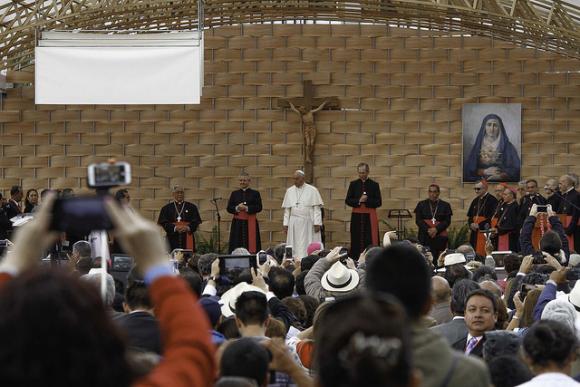
Given at Pontifical Catholic University of Ecuador on the occasion of his visit to Ecuador on 7 July 2015.


My Brother Bishops,
Father Rector,
Distinguished Authorities,
Dear Professors and Students,
Dear Friends,

I am very happy to be here with you this afternoon at the Pontifical Catholic University of Ecuador, which for almost sixty years has helped to further the Church’s educational mission in service to the men and women of this country. I am grateful for your kind words of welcome, which expressed your profound hopes and concerns in the face of the challenges, both personal and social, of your work as educators.

In the Gospel we have just heard, Jesus, the Master, teaches the crowds and the small group of his disciples by accommodating himself to their ability to understand. He does this with parables, like that of the sower (cf. Lk 8:4-15). He does it in a way that everyone can understand. Jesus does not seek to “play the professor”. Instead, he seeks to reach people’s hearts, their understanding and their lives, so that they may bear fruit.

The parable of the sower speaks to us of “cultivating”. It speaks of various kinds of soil, ways of sowing and bearing fruit, and how they are all related. Ever since the time of Genesis, God has quietly urged us to “cultivate and care for the earth”.

God does not only give us life: he gives us the earth, he gives us all of creation. He does not only give man a partner and endless possibilities: he also gives human beings a task, he gives them a mission. He invites them to be a part of his creative work and he says: “Cultivate it! I am giving you seeds, soil, water and sun. I am giving you your hands and those of your brothers and sisters. There it is, it is yours. It is a gift, a present, an offering. It is not something that can be bought or acquired. It precedes us and it will be there long after us.

Our world is a gift given to us by God so that, with him, we can make it our own. God did not will creation for himself, so he could see himself reflected in it. On the contrary: creation is a gift to be shared. It is the space that God gives us to build up with one another, to build a “we”. The world, history, all of time – this is the setting in which we build this “we” with God, with others, with the earth. This invitation is always present, more or less consciously in our life; it is always there.

But there is something else which is special. As Genesis recounts, after the word “cultivate”, another word immediately follows: “care”. Each explains the other. They go hand in hand. Those who do not cultivate do not care; those who do not care do not cultivate.

We are not only invited to share in the work of creation and to cultivate it, to make it grow and to develop it. We are also invited to care for it, to protect it, to be its guardians. Nowadays we are increasingly aware of how important this is. It is no longer a mere recommendation, but rather a requirement, “because of the harm we have inflicted on [the earth] by our irresponsible use and abuse of the goods with which God has endowed it. We have come to see ourselves as her lords and masters, entitled to plunder it at will… This is why the earth herself, burdened and laid waste, is among the most abandoned and maltreated of our poor” (Laudato Si’, 2).

There is a relationship between our life and that of mother earth, between the way we live and the gift we have received from God. “The human environment and the natural environment deteriorate together; we cannot adequately combat environmental degradation unless we attend to causes related to human and social degradation” (Laudato Si’, 48). Yet just as both can “deteriorate”, we can also say that they can “support one another and can be changed for the better”. This reciprocal relationship can lead to openness, transformation, and life, or to destruction and death.

One thing is certain: we can no longer turn our backs on reality, on our brothers and sisters, on mother earth. It is wrong to turn aside from what is happening all around us, as if certain situations did not exist or have nothing to do with our life.

Again and again we sense the urgency of the question which God put to Cain, “Where is your brother?” But I wonder if our answer continues to be: “Am I my brother’s keeper?” (Gen 4:9).
Here, in this university setting, it would be worthwhile reflecting on the way we educate about this earth of ours, which cries out to heaven.

Our academic institutions are seedbeds, places full of possibility, fertile soil which we must care for, cultivate and protect. Fertile soil thirsting for life.

My question to you, as educators, is this: Do you watch over your students, helping them to develop a critical sense, an open mind capable of caring for today’s world – a spirit capable of seeking new answers to the varied challenges that society sets before us? Are you able to encourage them not to disregard the world around them? Does our life, with its uncertainties, mysteries and questions, find a place in the university curriculum or different academic activities? Do we enable and support a constructive debate which fosters dialogue in the pursuit of a more humane world?

One avenue of reflection involves all of us, family, schools and teachers. How do we help our young people not to see a university degree as synonymous with higher status, money and social prestige. How can we help make their education a mark of greater responsibility in the face of today’s problems, the needs of the poor, concern for the environment?

I also have a question for you, dear students. You are Ecuador’s present and future, the seedbed of your society’s future growth. Do you realize that this time of study is not only a right, but a privilege? How many of your friends, known or unknown, would like to have a place in this house but, for various reasons, do not? To what extent do our studies help us feel solidarity with them?

Educational communities play an essential role in the enrichment of civic and cultural life. It is not enough to analyze and describe reality: there is a need to shape environments of creative thinking, discussions which develop alternatives to current problems, especially today.

Faced with the globalization of a technocratic paradigm which tends to believe “that every increase in power means an increase of progress itself, an advance in security, usefulness, welfare and vigor; …an assimilation of new values into the stream of culture, as if reality, goodness and truth automatically flow from technological and economic power as such” (Laudato Si’, 105), it is urgent that we keep reflecting on and talking about our current situation. We need to ask ourselves about the kind of culture we want not only for ourselves, but for our children and our grandchildren. We have received this earth as an inheritance, as a gift, in trust. We would do well to ask ourselves: “What kind of world do we want to leave behind? What meaning or direction do we want to give to our lives? Why have we been put here? What is the purpose of our work and all our efforts?” (cf. Laudato Si’, 160).

Personal initiatives are always necessary and good. But we are asked to go one step further: to start viewing reality in an organic and not fragmented way, to ask about where we stand in relation to others, inasmuch as “everything is interconnected” (Laudato Si’, 138).

As a university, as educational institutions, as teachers and students, life itself challenges us to answer this question: What does this world need us for? Where is your brother?
May the Holy Spirit inspire and accompany us, for he has summoned us, invited us, given us the opportunity and the duty to offer the best of ourselves. He is the same Spirit who on the first day of creation moved over the waters, ready to transform them, ready to bestow life. He is the same Spirit who gave the disciples the power of Pentecost.  The Spirit does not abandon us. He becomes one with us, so that we can encounter paths of new life. May he, the Spirit, always be our teacher and our companion along the way..


Source: Vatican Radio
Photo credit: andes.info.ec

30 June 2015

|

Tags: Educators, Parents

|

Categories: Reflections

Sr Delphine Kang RGS is the supervisor of Marymount Convent School.


What are your roles and responsibilities at Marymount Convent?
As supervisor in the only Good Shepherd School in Singapore, I ensure the school is on track in its mission, “reaching out with compassion and respect and empowering each person to develop her full potential holistically.” As a Religious of the Good Shepherd, I want to ensure that every child who comes to my school experience God in some way.

What are some of the difficulties in working in education?
As I am not directly involved in teaching and as the school programme is packed with a zillion things, getting a slice of time for spiritual things is a challenge. It is especially difficult to get a majority of pupils and staff to participate in optional Catholic activities like weekly Masses, adoration and other prayer sessions. While staff members are genuinely hard pressed for time, many shy away from the spiritual. I am pained and saddened by children whose parents forbid them to listen to Bible stories even as they send them to our mission school.

This cannot be easily overcome. However, I try to make things convenient and attractive, like meeting their schedules, and including their concerns and their families in the intentions. I also take every available opportunity at major school events to insert my presence and message of God’s abiding love for all. I hope that the hymns we insert at morning assemblies will touch the lives of all who are present, staff as well as pupils.

What is the fondest memory of your time working in the education sector?
There are many! The simplicity and joy of children, sometimes inexplicable; the sometimes good response of the staff and pupils in celebrations like Foundress Day and Easter; a couple of occasions when staff members or pupils are baptised at Easter; the commitment of parent volunteer catechists; and the annual P6 retreat camps that impact the participants greatly.

When you are faced with difficult students, what is one thing you tell yourself?
They are beloved children of God and His love will help overcome the challenges. Have patience, God has all the time. I lift them up in prayer that hand them over to the Lord to take charge of them.

What does being a Catholic educator mean to you?
While not diminishing the importance of academic excellence and holistic formation of our children, God has the first place in all things and is of primary importance in my life as an educator, and I want to transmit this priority to our children.

Why is education an important aspect of Good Shepherd Sisters?
Education – formal education – is secondary to the Good Shepherd Mission. Our main thrust is towards the socially marginalised, disadvantaged women and children. However, as education also falls within the ambit of our Mission, it provides a platform for some vital focus, like awareness raising for social issues – peace and justice, poverty, human trafficking, environment, migrant workers, and so on – as well as sowing the seeds of faith, and for character formation.

What is one thing about the founder of your congregation that inspires you?
Our Mother Foundress, St. Mary Euphrasia (1794-1868), was a visionary whose life, works and words remain ever relevant today. One of her many inspirations that I treasure is, “I was not possessed of great talents… I only loved. But I loved with all the strength of my soul.” One thing about her that I try to emulate and pass on to my school is gratitude. Despite numerous challenges in her life and mission, St Mary was ever thankful to God and exhorted her sisters to do the same. Gratitude is what keeps the flame of zeal alive even in the midst of discouragement and difficulties.

Has a student ever inspired you or taught you something valuable?
Yes, now and again I meet with students who are very respectful, full of gratitude and are helpful and self-giving. Most of all these are happy children and I use them as examples in my attempt to inspire others. Each time I see children bowed to the ground at the children’s adoration sessions, I am reminded of the call of Jesus to be like them… simple, humble and trusting.

How about the teachers you work with?
Thankfully, we have many teachers who are committed, focused on the school’s mission, are patient, caring, and who often go beyond the call of duty. I am encouraged and inspired by them to do my part and go the extra mile whenever the occasion arises.

What is one aspect or character of a Catholic school that you appreciate the most?
That we begin the day with a prayer and promote and practice Gospel values.

What difference would it make if Catholic parents enrolled their children in a Catholic school?
A Catholic school would help reinforce the faith of a Catholic child and sow the seeds of faith in a non-Catholic child, as well as build strong characters with the values of Jesus, the way of love, truth, and fullness of life. The Catholic environment of the school should instil in her pupils the things that matter most in life and a sense of self-worth based on an unselfish life of sharing, caring and giving.

What is one advice you would give to teachers today?
Teachers: yours is a noble vocation. Your words and actions impact the children you teach one way or the other. They look to you for inspiration and guidance. Love them and they will love you and loving you they will do well. Be a teacher like unto your Teacher (Jesus). Find time daily to sit at His feet to feel His love and listen to His wisdom. Take Him as your inspiration; love your pupils with His love. Be blessed and be a blessing to others.

26 June 2015

|

Tags: Educators

|

Categories: Reflections, Saints

Amidst the important, amazing, and inspiring acts of faith that Sts Peter and Paul have done in their lives, two simple aspects of these saints are in fact more than enough for educators to draw inspiration from.


Sts Peter and Paul are arguably two of the most important and well-known saints of the Catholic Church. Their names are known around the world, respected by all denominations of Christianity, even some non-Christians, and remembered throughout history. Since the second century, there has been historical evidence of the early Church’s commemoration of these two saints on the same day, due to their complementary role in leading and establishing early Christianity.

As we continue the tradition of commemorating the two saints, let us take some time to look again at the examples of these saints, from whom two simple, yet special lessons for educators can be drawn. Amidst the incredible testimony of the lives of Sts Peter and Paul, amazing acts of faith, and other seemingly impossible achievements, it is in fact their simple characteristics that make them all the more inspiring.

Perfection
It is sometimes common for feelings of inadequacy to seep into the hearts of educators, who are placed in charge of so many young lives and who hold such influence over the development of a human person. After all, if one is already cautious when putting ink to paper, then how much more does it entail when a teacher inscribes on the very hearts of children?

A reflection on the person St Peter was during his life however, would show that in fact, the more unworthy we may think we are, the stronger God can be in our human weakness. St Peter, who was called Simon previously, was a humble fisherman who did not have any skills or knowledge one would expect in a preacher or a great leader. And yet, this was the man Jesus chose to lead the Catholic Church, and St Peter had not only done so with tremendous faith, but with amazing courage as well.

St Peter had not been the most perfect preacher, the most perfect leader, or even the most perfect believer. There were many times in the gospels where we see St Peter’s human weakness. Such as when he was willing to accept Jesus’ doctrine of forgiveness, but suggests a limit of seven times. He walks on the water in faith, but sinks in doubt. He swears at the Last Supper that he will never deny Jesus, and then swears to a servant maid that he has never known the man.

But despite all these events that would have made any human person deem St Peter as an inadequate leader, St Peter was still perfect for the job in the eyes of Jesus, as He affirms, “You are Peter, and on this rock I will build my church, and the gates of Hades will not prevail against it” (Matt 16:18).

Courage in Christ
When the Holy Spirit washed over the apostles on Pentecost and a large crowd was attracted by the commotion, it was St Peter who stood up, preached, and explained that this was the work of the Holy Spirit. Right there on that very day, St Peter converted thousands.

In the Acts of the Apostles subsequently, St Peter boldly led the apostles to foreign lands to preach and heal the sick in the name of Jesus. Even after being captured, beaten, and threatened by the Pharisees to stop their ministry, St Peter and the apostles “went on ceaselessly teaching and proclaiming the good news of Christ Jesus” (Acts 5:42).

The secret to St Peter’s courage can be traced back to when Jesus questions him three times, “Do you love me?” And St Peter, exasperated and at his wit’s end, simply affirms, “Lord, you know everything; you know that I love you.”

For educators, it is tempting sometimes to judge ourselves by our human standards as inadequate for our role, or to think that we may be too imperfect. But God surely judges us by better standards, and He has considered us worthy to be called as teachers. If we only love God the same simple way St Peter did, then we can have courage in the faith that God can work miracles with us, no matter how inadequate we may think we are.

The science of Jesus
As we reflect on how St Peter’s simple love for Jesus enabled God to work such miracles through him, another question comes to mind; how then can I come to love Jesus in the same way? This is where the life of St Paul sheds more light for us, especially as educators.

“Why is Jesus, the adorable, eternal and incarnate Wisdom loved so little if not because he is either too little known or not known at all? Hardly anyone studies the supreme science of Jesus, as did St. Paul,” St Louis de Montfort describes in his book, The Love of Eternal Wisdom.

St Paul was truly a scientist when it came to studying the teachings and revelations of Jesus. A majority of the New Testament has been attributed to the authorship of St Paul, many of which are fundamental teachings of the Church and continue to provide direction for us today.

Coupling the fact that St Paul had such divine understanding of Jesus, with the amount of zealous love he displayed during his service to God, one can easily draw a relation between a love for Jesus, and a knowledge for Him. This can be clearly seen in the many letters St Paul writes, when he tries to explain what is right or wrong according to Jesus’ teachings, and in the many occasions he suffers for proclaiming Jesus as the son of God.

Knowledge as a tool
St Paul not only studied the science of Jesus to increase his love for God, but also used this knowledge to better evangelise. St Paul, who had been one of the most zealous persecutors of Christianity before his conversion, was certainly learned in the Jewish customs and teachings. He had even described himself as a Pharisee in his letter to the Philippians, “Circumcised on the eighth day, a member of the people of Israel, of the tribe of Benjamin, a Hebrew born of Hebrews; as to the law, a Pharisee” (Phi 3:5).

With this knowledge, St Paul had a particular style of spreading the Good News by appealing to the intellect of those listening. In chapter 13 of the Acts of the Apostles for example, St Paul was preaching to a crowd of Gentiles and explained the Old Testament, everything from Israel in the desert, to King David, the prophet Samuel, up to John the Baptist. St Peter used all these examples and explained how each of them were in fact referring to Jesus, who was crucified and raised from the dead.

As educators then, let us never stop learning and studying the most noble and useful of all sciences, just as St Paul had done. This not only helps us to better respond to our call to evangelise, but it also certainly brings us to a deeper love for God.