18 June 2015

|

Tags: Educators, Parents, Students

|

Categories: News

Archbishop William Goh Prayer Intention June 2015

Archbishop William Goh’s prayer intention for June 2015 is for Catholic schools: “That Catholic educators will be more courageous in the proclaimation of the Gospel as they form young people in truth and love; that the Catholic Ethos to be strengthened in our Catholic schools.”

Please make a mention for this intention when you pray this month.

15 June 2015

|

Tags: Educators, Parents

|

Categories: Reflections

Over dramatisation of any scripture text is never a good idea especially when you want to create the understanding that God speaks through his word. However, when telling Bible stories to young children, some emphasis and additional inflection may be needed for better grasp of the story and for greater engagement. The teacher’s personal preparation can make all the difference to the faith experience of the children. Here are some steps you can take.

1. Read the whole text from an adult Bible and carry out the following exercise if you have time before going to the children’s Bible.

2. Ask yourself these questions for greater personal insight:

  • What is the context of this story – where is it happening? What happened just before? What is coming next?
  • What is the purpose of this particular book of the Bible?

3. Ask yourself the following questions when preparing to tell a particular story:

  • What is the key message this story is putting across that I need to get across?
  • What do I want my listeners to feel?
  • Which words should I highlight?
  • Where does the mood change – from fear to confidence; from defiance to adoration; from despair to trust; from complaining to obedience and peace etc? See Exodus 14: 10-31 for example and practice reading it with changes to your voice and mood.
  • Is there a climax in the story?
  • Where would be the places to pause?
  • Which difficult words do I need to practice?


4. Read the text again and again from the Children’s Bible or Good News bible.


5. Look up at your listeners more than at the text.


6. Always allow a pause after the reading and keep still.

Feel free to adapt these tips, and feel free to give us your feedback.


By Wendy Louis

10 June 2015

|

Tags: Educators, Parents

|

Categories: News, Reflections

The complexity of the modern world makes it all the more necessary to increase awareness of the ecclesial identity of the Catholic school. It is from its Catholic identity that the school derives its original characteristics and its “structure” as a genuine instrument of the Church, a place of real and specific pastoral ministry. The Catholic school participates in the evangelizing mission of the Church and is the privileged environment in which Christian education is carried out. In this way “Catholic schools are at once places of evangelization, of complete formation, of inculturation, of apprenticeship in a lively dialogue between young people of different religions and social backgrounds” (John Paul II, Apostolic Exhortation Ecclesia in Africa, n. 102). The ecclesial nature of the Catholic school, therefore, is written in the very heart of its identity as a teaching institution. It is a true and proper ecclesial entity by reason of its educational activity, “in which faith, culture and life are brought into harmony” (Congregation for Catholic Education, Religious Dimension of Education in a Catholic school, n. 34.). Thus it must be strongly emphasized that this ecclesial dimension is not a mere adjunct, but is a proper and specific attribute, a distinctive characteristic which penetrates and informs every moment of its educational activity, a fundamental part of its very identity and the focus of its mission (cf. Congregation for Catholic Education, Religious Dimension of Education in a Catholic school, n. 33). The fostering of this dimension should be the aim of all those who make up the educating community.

From: The Catholic school On the threshold of the third millennium, 28 December 1997, Congregation for Catholic Education (for Seminaries and Educational Institutions)

2 June 2015

|

Tags: Educators

|

Categories: Resources

Teaching can be notoriously difficult and draining on the soul. Take some time during the June holidays to explore these 10 guaranteed ways a teacher can recharge spiritually, emotionally, and physically!


10. Live a day of tech detox.
No phones, no computers, no TVs, no internet, no technology. Like all our precious smart devices, our lives need recharging too, and these things that we unknowingly spend so much time on seriously distracts us from the small moments of beauty in everyday life. The statement, “God is everywhere”, though we sometimes tend to read as figure of speech, is in fact meant to be understood literally.

While some daily tasks might inevitably become more challenging now that technology have integrated so much into our lives, nothing is entirely impossible. Plan ahead for this as well, so that the anxiety of being “cut-off” may not be overwhelming. Let friends and family know that you will be uncontactable for a day, and set up an emergency contact through other means such as the home phone instead. Detox yourself of all these that constantly demands your attention, and refocus your entire being on the presence of God in everything around you and in you.


9. Seek Gratitude.
Try to live a full day in a disposition of gratitude, and allow everything to be transformed by it. Imagine putting on glasses of gratitude before you start the day; everything you experience or encounter now goes through a gratitude filter first, before reaching your eyes. While this may be easier said than done, we can start with the simple things and it will grow on you more easily than expected. The sound of children playing in the distance, those quirky habits of loved ones that only you notice, or even a random inanimate object that looks like a funny face.

We often allow our thoughts to be so filled with work and busyness that naturally, the grace of gratitude is one of the first things we forget about. With a little more time during the holidays now, let us actively seek to bring this grace back into our hearts. Slowly, even seemingly negative events in life can contain a cause for gratitude to God.


8. Reconnect with someone important to you.
Your spouse, partner, parents, friends, children, and so on. Has there been someone in your life you regard with significance, but may have neglected to spend time with? The June holidays present us with the perfect opportunity to reconnect with these important people. And remember, connecting with someone implies something much more profound! The popular term we like to use is “HTHT” or “heart to heart talk”. Though a little cheesy and awkward, the term does help remind us what is truly important – the conversation, and not the activity, venue, or even context for a meeting.

Even if this is someone we see daily, or even share a house with, sincere connection can be difficult for a busy and exhausted teacher. Sincere connection requires time and effort on your part to listen as well as share about yourself. But this is one of the surest ways of feeling instantly refreshed and energised, since God has made humans social creatures, modelled after His own Trinitarian self.


7. Start an exercise regime.
This can be as simple as a 10 minute run in the morning, or as intricate as a planned workout programme. But what is important is to keep this constant, develop it into a habit and make it a regime that you follow at a constant rate. Of course, teachers will know that exercise helps with stress because of the increased production of the endorphin hormone. But exercise really should not be looked at as a quick fix, but as a constant in our lives.

Regulating the chemical make-up of our physical selves will not only lead to a healthy body, but also a healthy mind. In fact, a third dimension can benefit from a regular exercise regime as well – faith. When you feel like giving up during a run, when your muscles burn and you question why you torture yourself, you can offer this suffering as a form of prayer for someone too. By putting yourself on an exercise regime, you can in fact strengthen body, mind and faith.


6. Let the love flow.
Spend some time to volunteer at a charitable cause or in a ministry at church! While it sounds counter-productive to engage in more activities in hopes of recharging ourselves, you will realise that we often in fact receive more than we give.

One favourite analogy used to describe this is the example of the Sea of Galilee and the Dead Sea. Both are lakes fed by the same waters from the Jordan River, but one lake is teeming with flora and fauna, while the other is… well, dead. Our souls are very much like these lakes, where we produce much fruit and support life if we allow love to flow both into and out of us. But if we only seek to receive love and not let it flow out, our souls might become like a dead sea. So take the opportunity this month to let the love flow! After all, “faith by itself, if it has no works, is dead” (Jam 2:17).


5. Rediscover God in nature.
Much like the way artists leave a signature or some form of identifying mark in their works, God has also undoubtedly left an imprint in every creation. After forming each one, God had declared every creation to be good. And this wealth of goodness still surrounds us today, given to us in love, and certainly avenues where we can revitalise our tired bones with God’s own presence. All we need to do really, is to remember to stop and smell the flowers.

Try immersing yourself in nature again, and ask yourself, Where are you?” It is a strange but charming question that reminds us to notice everything, even the tiniest details, and with all five senses of the body. It is one thing to walk past the trees and see that they are green, but it is an entire different experience to also hear them swaying in the wind, to notice the kind of fruits it bears, and to see the birds hidden in its foliage.


4. Participate in a retreat.
Retreats are one of the best ways to find spiritual solace, and to ease yourself back into God’s grace. To actively take yourself out from the world for a few days, and to fill your schedule with prayer and reflection instead certainly does wonders for the soul. In his encyclical, Deus Caritas Est (God is Love), Pope Benedict XVI reminds us that, “Anyone who wishes to give love must also receive love as a gift.”

By attending a retreat, you are allowing yourself the space and time to open your heart again to a God who does not stop loving us; it is often us who forget to accept this love. Thankfully, the Catholic Church in Singapore is wonderfully active when it comes to retreats. In fact, there are two retreats happening in June 2015 which you might like to consider:


  • Marriage Retorno Weekend (for married couples only)
  • Divine Love Retreat with Fr Vallooran

You could also try exploring the many programmes organised by the several Catholic retreat centres here. Most of these programmes are also available to anyone, regardless of age, gender, race or religion.


3. Spiritual reading.
Spiritual reading is the practice of reading books for the purpose of growing in holiness. Different from lectio divina which focuses on the bible, spiritual reading can be done with many different books such as the writings of the Doctors and Fathers of the Church, lives of the saints, doctrinal writings, and so on. Many saints of the Church have described spiritual reading as an invaluable source of inspiration and strength to them, and have fervently recommended this practice.

St Josemaría Escrivá likens spiritual reading to building up a store of fuel, “It looks like a lifeless heap, but I often find that my memory, of its own accord, will draw from it material which fills my prayer with life and inflames my thanksgiving after Communion.” If we commonly read self-help books on business, management, health, and so on, then what puts us off when it comes to books on spirituality? While spiritual reading does not sound particularly relaxing, especially since it involves some deep thought and reflection, we can trust the advice of St Escrivá to build a store of fuel in ourselves through reading, so that we are better prepared to handle the demands of teaching. On this page, a list of recommended reading is freely available.


2. Interior prayer.
Interior prayer, or mental prayer, is a form of prayer where one loves God through dialogue, meditation, and contemplation of God’s words. It is distinguished from other forms of prayer which uses set prayers. One of the most important writers of interior prayer is St Teresa of Avila, who describes, “Contemplative prayer is nothing else than a close sharing between friends; it means taking time frequently to be alone with him who we know loves us.” If there are any similarities between the thousands of saints of the Catholic Church throughout history, it is that every one of them held a deeply personal relationship with God through prayer. What better way is there to revitalise our weary hearts than to go to the source of life?

St Jean-Baptiste de La Salle, patron saint of teachers, had been a firm advocate for interior prayer. He believed that teachers and students should be taught to pray in this way, and wrote an easy to read book, Explanation of the Method of Interior Prayer, for this purpose. It might please you to know that this work is freely available here.


1. Receive the Sacraments (more regularly).
Finally, the number one recommended and most effective way we can recharge ourselves is none other than through the sacraments! The Catechism of the Catholic Church states, “The whole liturgical life of the Church revolves around the Eucharistic sacrifice and the sacraments.” The seven sacraments have long been a sacred tradition in the Catholic Church, instituted by Christ Himself, practiced by the apostles and the early Church, and passed on through history. Today, we are incredibly blessed with the opportunity to continue participating in such important and real signs of the faith in Jesus, through His Church.

“Sacraments are ‘powers that comes forth’ from the Body of Christ, which is ever-living and life-giving. They are actions of the Holy Spirit at work in his Body, the Church. They are ‘the masterworks of God’ in the new and everlasting covenant.” (CCC 1116). With a little more time on our hands now, there is really no better way of refreshing yourself and preparing for the new school term, than to experience God through His sacraments, which are so easily and widely available to us!

2 June 2015

|

Tags: Educators

|

Categories: Homilies / Messages, News

Given at Westminster Cathedral at Vespers on the occasion of his installation as inaugural Chancellor of St Mary’s University, Twickenham, on 27 May 2015


This is a wonderfully formal ceremony, rich in content and significance. Perhaps for the next few minutes I can be a little less formal and a little more personal.

It is a great privilege and pleasure to take on this role as Chancellor. There have been many moments of preparation. One always comes up. What I am going to wear!

Decision taken was that I remain in the formal dress of Cardinal as the suitable garb for the Chancellor. A clear statement, among many this afternoon, that our University sees itself as an expression of all that is best in the tradition and life of the Catholic faith. Doing so gives the University strong and deep roots and a stability of culture that no secular designation can bring.

When I think of St Mary’s, two people come into my mind.

The first is Pope Benedict, with his remarkable visit to the University in 2010. Look at what he did. First he met with and spoke to the men and women religious of England and Wales. Please read again the speech he gave, touching on the history of the University, the world-wide commitment of the Catholic Church to the work of education, ‘often laying the foundations of educational provision long before the State assumed responsibility for this vital service  to the individual and society.’ Deep historical roots indeed.

Then he met with the children, in the Big School Assembly. There he spoke to the heart of the invitation to life that is served by education. As is noted in the booklet, he invited the children ‘to become saints’, explaining that this meant never being satisfied with second best. His words: ‘I am asking you not to pursue one limited goal and ignore others. Having money makes it possible to be generous and to do good, but on its own it is not enough to make us happy. Being highly skilled in some activity or profession is indeed good, but it will not satisfy us unless we aim for something greater still. It might make us famous, but it will not make us happy…..In your Catholic schools, there is always a bigger picture over and above individual subjects you study, the different skills you learn. All you do is placed in the context of God and from that flows friendship with God’ and that is the ultimate source of our happiness. A vision of education for us to keep before our eyes.

Then he went to the Waldegrave Room and met with leaders from all sectors of society who were of other religious faiths. This was the strongest of all signals of the true breadth of the project of St Mary’s: that of bringing together, in every profession, in every walk of life, the strengths and resources of religious faith together with the best of scientific and contemporary endeavour. He stressed this: ‘The quest for the sacred does not devalue other fields of human enquiry. On the contrary it places them in a context which magnifies their importance as ways of responsibly exercising our stewardship over creation.’ As broad a mandate as you could wish.

This visit, and this person, Pope Benedict, stands, for me, as a strong sign of the path still to be followed by St Mary’s, in depth of endeavour, in vision of education and it wholeness of life.

The second person is not at all well known, but for me no less important. It is my father. In circumstances that I do not need to explain now, he found himself needing to acquire formal teaching qualifications, even though for five or more years he had been teaching in various classrooms. So he became a student of St Mary’s – or Simmaries as it was known.

He was a great teacher and a fine man, expressing in daily down-to-earth life precisely the qualities I have been speaking about. In the later part of his career he was approached a number of times about being a head teacher. He would have none of it. He said his joy and calling lay in standing in front of a class of ‘little nippers’ and seeing their minds and lives slowly opening to the wonders of life and learning. He was generous, staying on after school hours to provide what was known as the ‘play school’ but actually was to enable children to wait in safety  until their parents came home from work and, while they waited, to get on with their homework for that was nigh impossible once they got home. Later in his career he switched to primary school teaching, just to take on a new challenge. One of my cherished home memories is of my parents talking together, long into the evening, about what they were doing in the classroom, for my Mum too was a wonderful primary school teacher.

At this moment I can hear him telling me to stop. That’s more than enough, he is saying. Have you no sense about how long you should go on for – most priests don’t, he is adding! But there is one more thing I want to say. Just one sentence from the reading we have heard this afternoon: ‘Accept the strength that comes from the grace of Christ.’

I hope those words long remain at the centre of your lives, both individually and as an institution. You have seen your Vice-Chancellor receive a very formal mandate and give a very solemn undertaking. This is indeed a mandate of the Church, but, just as importantly, it is an invitation to rely on someone who is beyond all doubt and defeat, the one alone who has conquered the evil and death which is written into our world. He indeed is our source of courage and also our source of joy. In him may St Mary’s always be a place of great joy, Gospel joy. Then it will indeed prosper. Amen.


Given at Westminster Cathedral, London
27 May 2015, the Feast of St Augustine of Canterbury

Source: rcdow.org.uk
Photo credit: stmarys.ac.uk

29 May 2015

|

Tags: Educators

|

Categories: Reflections

Geraint Wong teaches English Language at CHIJ Secondary.


Why did you want to be a teacher?
I’ve always found joy in nurturing and developing young people. Plus, after giving tuition and doing relief teaching during my university days, I found I had the gift of explaining things clearly, so teaching became a natural path to take. But – and this may surprise some people – I didn’t quite settle on it till my honours year.

What is the biggest challenge you face as a Catholic educator?
I don’t think being a Catholic educator is any different from being an educator in general, because being an educator entails being a role model to students. In the case of a Catholic, this means being a witness to Gospel values, but in a general sense it means espousing good values – in short, being true to yourself and what you believe in, whether you are Catholic or not. But this isn’t the biggest challenge. To me, the biggest challenge in being an educator is having enough time for my students (which includes preparing good lessons and giving them timely and valuable feedback on their work) in the midst of all the other work I have to do.

What were you doing before becoming a teacher?
University – did my bachelor’s, honours and master’s degree consecutively before I started work. Before university I did a short stint at the front office of a hotel – enjoyed that job thoroughly, but I didn’t stay on because the prospects didn’t seem that great.

What is your fondest memory/experience as a teacher?
There have been so many that it’s difficult to single out specific instances. In general, I’ve always enjoyed the times I’ve worked with students outside the classroom setting – such as meetings with student leaders, training of emcees, even informal chats with students filled with banter and laughter.

Has your faith affected you in your role as a teacher in any way?
Definitely. I am acutely aware of how the Holy Spirit is constantly guiding and inspiring me in my teaching vocation – I would never have achieved what I have all these years without him. I also try to approach my students the way Jesus approached his disciples and the crowds that followed him – with compassion and a deep respect for their personhood.

What are some of your key priorities as a teacher?
My students always come first. Sadly, however, administrative work often cries out for attention and competes for my time – but it’s often a necessary evil.

What is one way you try to inspire your students?
By being true to myself and sharing my experiences, or other stories that I’ve heard or encountered, with them.

Do you try to share your faith with students? How so?
In Religious Education classes, yes, explicitly, by sharing my faith journey and experiences. I’m also in charge of Spirituality in my school, and when we have practices for Masses, I take the opportunity to explain some aspects of the faith or the liturgy with the classes involved (which include non-Catholics). In other contexts, I do so more subtly and indirectly, preferring to lead by example. I think the most edifying thing a student (who wasn’t in my RE class) ever told me was, “You make me want to be a better Catholic.” That was enough of an affirmation for me.

What do you like most about being a Catholic?
Hmmm. I’d say the good balance between “structure” (the Church, the sacraments, the liturgy, etc) and the more personal “unstructured” aspects of the faith (personal prayer, relationship with God). I think God in his infinite wisdom knew all along that we need both in our lives to sustain our faith and commitment.

How do you keep close to God?
Daily quiet time, informal conversational prayer throughout the day, attending weekday Masses whenever possible.

What brings you joy in life?
Accomplishing things. This can range from big things like seeing a project through to its completion, to small things like seeing the look of understanding or enlightenment on a student’s face when she gets what I’m trying to say.

What is your favourite scripture passage?
I have a few. I guess my top two are John 10:10 – The thief comes in order to steal, kill, and destroy. I have come in order that you might have life, life in all its fullness. And Jeremiah 29:11 – I alone know the plans I have for you, plans to bring you prosperity and not disaster, plans to bring about the future you hope for. They are my greatest motivations for hope and optimism in life.

If you weren’t a teacher today, how different would your life have been?
I’d likely have a lot more time on my hands! In fact, I did leave the teaching service for 1.5 years, from Jan 2011 to Jun 2012, to work with The Straits Times Schools team. It was a good experience that taught me many things (chief among which was honing my writing craft), but eventually I found that I was lacking the fulfilment that came with the daily interaction with students, so I returned.

28 May 2015

|

Tags: Educators

|

Categories: Reflections, Saints

As we end the month Mary, let us reflect and remind ourselves again of the important lessons Our Lady teaches us by her example.


The special dedication of the month of May to the Blessed Virgin Mary has long been a tradition of the Catholic Church, where the faithful engage in more fervent and loving acts of homage and veneration. In the midst of prayer and deeper reflection, Mary’s May is the opportune time to look once again on Mary’s “yes”, and what her example teaches us.

From the accounts of several saints and from the various approved Marian apparitions throughout history, we see that the Blessed Virgin is in fact, not only a loving mother and intercessor, but also a great educator for all Christians.

There are many great lessons that Mary teaches us, but there are two aspects in which we, as educators, can draw special reflection – Mary’s role as teacher during her time on earth, and the “school” of her Immaculate Heart.

The teacher’s teacher

Learning about Mary from the accounts of the Gospels, it is natural and beneficial for us to view her as our dear mother and guide. However, the Gospels also certainly tell of Mary’s role as our teacher, such as when she instructed the servants at the wedding at Cana, “do whatever He tells you” (John 1:5).

Education was in fact one of the major responsibilities of Mary, albeit lesser known. This is seen most clearly in her duty of teaching Jesus and bringing Him up in this world according to God’s plans.

Though we do not have more detailed accounts of Jesus’ early life, His nature as both fully God and fully man, who went through normal human growth, certainly makes the case of Mary’s role as teacher of Jesus undeniable.

In the Catechism of the Catholic Church, the duty of parents and educators is in fact described as inseparable, as “parents have the first responsibility for the education of their children. They bear witness to this responsibility first by creating a home where tenderness, forgiveness, respect, fidelity, and disinterested service are the rule” (CCC 2223).

Mary has been blessed with the authority to be a worthy enough educator to Jesus because she was filled with graces from the Holy Spirit. When the angel visited her, the greeting started with the famous, “Hail, full of grace, the Lord is with you!” (Luke 1:28).

At the same time, it is important to also note that the graces which Mary has been blessed with certainly required her obedience, as she would not have been a teacher at all if she had not responded to God with her perfect “yes”.

From the accounts of the first visitation, all the way to the foot of the cross, and up to her own assumption, Mary had always declared with her voice or by her actions, “Here am I, the servant of the Lord; let it be with me according to your word” (Luke 1:38).

Similarly as educators, do we strive to teach with the authority of the Holy Spirit? Do we allow ourselves to receive the gifts God wants to give us? It is through obedience to God and an openness to the Holy Spirit, that we can be sure we have what it takes to be an educator worthy of the students God brings into our lives.

When we encounter challenging students, broken students, and are put in charge of so many at once that we feel overwhelmed, Mary teaches us that obedience to God’s will and an openness to His Spirit will surely empower us with the gifts and strength we often yearn for.

School of Mary

Besides Jesus, our greatest teacher and the only way through whom we can approach the knowledge of God, and the Holy Spirit, whom brings us toward Jesus, God has truly blessed mankind with the gift of another avenue where we can seek and learn about Him – our Mother Mary.

In an apostolic letter, Rosarium Virginis Mariae, Pope John Paul II described, ““From the divine standpoint, the Spirit is the interior teacher who leads us to the full truth of Christ. But among creatures, no one knows Christ better than Mary; no one can introduce us to a profound knowledge of His mystery better than His mother.”

Right from the beginning when the shepherds visited Jesus in the manger, it was described that Mary “kept all these things, pondering them in her heart” (Lk 2:19). A little later on, the Holy Spirit reveals through the prophet Simeon, “and a sword will pierce your soul too – so that the secret thoughts of many may be laid bare” (Luke 2:35).

The school of Mary certainly lies within her Immaculate Heart, where Mary kept and pondered on all the mysteries and miracles of Jesus. When she went through her own emotional crucifixion as she watched Jesus being condemned, her own strength and trust in God truly testified to the value of these lessons she holds in the school of her heart.

When we face difficulty and suffering in our lives, we commonly ask God, “why?” But even though Mary faced the most appropriate situation for such a question at the foot of the cross, where senseless violence was slowly killing her son, she did not ask why. Instead, she simply offered Jesus her loving motherly presence, and continued to trust that this is God’s will.

Mary, as human as we are in every way, shows us that a heart filled with God truly makes any suffering bearable, and she lovingly opens this heart for us to reflect and learn from.

“This school of Mary is all the more effective if we consider that she teaches by obtaining for us in abundance the gifts of the Holy Spirit, even as she offers us the incomparable example of her own ‘pilgrimage of faith’,” Pope John Paul II wrote in Rosarium Virginis Mariae.

Mary continues to be our mother and teacher today, whose immaculate heart, so full of invaluable knowledge of Jesus, remains open to us to reach out to. Let us take some time, especially within this month, to ponder again on the lessons we can learn from her.

22 May 2015

|

Tags: Educators, Parents

|

Categories: Reflections

As we celebrate Pentecost, let us remember the gits that God freely blesses us with, and what they mean for us as educators and parents.


Have you ever been so absorbed in the busyness of life that you forgot to open a gift? Perhaps a Christmas present you only opened after the New Year? Or that birthday card you only read a month later? As silly as it sounds, many of us do in fact go through life without ever realising we sometimes forget to open the greatest gift we have – the Holy Spirit.

The gift of the Holy Spirit, infinitely good and beneficial to us in so many ways, is indeed offered freely to everyone. But often, we are so absorbed in the activities of modern life that we simply forget to open this gift and use it to its fullest ability.

As we celebrate Pentecost, let us remind ourselves what it truly means to receive the Holy Spirit, and what the significance is for us as educators and parents.

Receiving a gift
The Holy Spirit is offered to you. Whether baptised yet or not, there is no doubt that God unconditionally offers His Spirit to all, because He calls everyone to Himself. “Since all men possess a rational soul and are created in God’s likeness, since they have the same nature and origin, we have been redeemed by Christ and enjoy the same divine calling and destiny,” Pope Paul IV writes in Gaudium et Spes.

All we need to do to attain such an incomparably rich gift then, is to simply reach out for it through baptism. During Pentecost, when the Holy Spirit manifested as tongues of fire and attracted a crowd to the apostles, St Peter had stood up and declared, “Every one of you must be baptised in the name of Jesus Christ for the forgiveness of your sins, and you will receive the gift of the Holy Spirit. The promise that was made is… for all those whom the Lord our God is calling to himself” (Acts 2:38-39).

However it is also important to be aware that receiving a gift does not only stop at acceptance. There is also the next step of actively opening this gift and allowing ourselves to be blessed by it. After all, what sense would it make to accept a present but keep it in its wrapping? Or what sense is there to order pizza but only admire the box and let its contents go cold?

Act1v8!
This is why the term, “Act1v8”, a play on the word “activate” and “acts 1, verse 8”, still holds a truly relevant reminder to educators and parents. Do we remember to regularly activate the Holy Spirit who dwells in us?

Here, the emphasised verse from the Acts of the Apostles is Jesus’ proclamation that, “You will receive the power of the Holy Spirit which will come on you, and then you will be my witnesses not only in Jerusalem but throughout Judaea and Samaria, and indeed to earth’s remotest end” (Acts 1:8).

There is an undoubtedly energetic tone as Jesus describes the power that will guide His disciples to witness to even the remotest ends of the earth. And this very same energy truly dwells in us, prompting and guiding us on the same mission – to reach even the remotest hearts of our students and children.

The upbringing of children for God is one of the greatest areas of work in the Church, and teachers and parents are the blessed ones called to this important mission. In the 1997 Vatican document, The Catholic School on the Threshold of the Third Millennium, teaching is described to have “an extraordinary moral depth and is one of man’s most excellent and creative activities, for the teacher does not write on inanimate material, but on the very spirits of human beings.”

This is why it is important to be aware of the gift of the Holy Spirit we have received (or called to receive for those not yet baptised), and the wealth of graces we can find in this great gift!

When the Spirit manifests
When the Holy Spirit was activated in the apostles during Pentecost, not only were the signs of the Spirit noticeable in the form of tongues of fire and a loud gushing wind, but more importantly, the work of the Spirit through each apostle was so powerful that thousands were converted that very day.

In the Acts of the Apostles, it was described that a crowd of various nationalities gathered upon hearing the gushing sound, and were “amazed and astonished” (Acts 2:7) to see the apostles speaking in their own native languages. A little later on, the crowd were “cut to the heart” (Acts 2:37) as they listened to St Peter explain that this was the work of the Holy Spirit, who was promised by Christ Jesus whom they crucified. That very day, about three thousand “accepted what he said and were baptised” (Acts 2:41).

When we struggle to reach the hearts of our students and children, when we feel as if our words fall on deaf ears, let us remind ourselves that this very same Spirit that empowered the apostles to speak in such a way that cut to the heart of those listening, also dwells in us this very moment.

With this knowledge, we can approach our everyday responsibilities with a renewed strength and joy, because we are truly blessed by God with everything we need to follow His call. “For you did not receive the spirit of slavery to fall back into fear, but you have received the spirit of sonship. When we cry ‘Abba! Father!’, it is the Spirit Himself bearing witness with our spirit that we are children of God, and if children, then heirs, heirs of God and fellow heirs with Christ, provided we suffer with him in order that we may also be glorified with him” (Rom 8:15-17).

19 May 2015

|

Tags: Educators

|

Categories: News, Saints

Pope Francis‬ canonised four ‪nuns‬ this past Sunday. One of them is Sister Marie Alphonsine Danil Ghattas‬, born in ‪Jerusalem‬ in 1847.

St Ghattas opened girls’ schools, fought for female illiteracy, and co-founded the Congregation of the Sisters of the Rosary, an order that boasts dozens of centres all over the Middle East today, operating ‪kindergartens‬, homes for the elderly, medical clinics and guest houses.

In his homily, the Holy Father said that Ghattas understood clearly what it means to radiate the love of God, and to be a witness to meekness and unity. The pope said: “She shows us the importance of becoming responsible for one another, of living lives of service one to another”. The four newly canonised saints, he said, challenge us, by “their luminous example”to ask: how we can bear witness to the risen Christ.

Jordanian Fr Rifat Bader, director of the Catholic Center for Studies and Media in Amman, said that in the late 19th and early 20th centuries, St Marie-Alphonsine’s congregation “had a decisive role in the promotion of the Arab woman in the fields of culture, education and teaching” and to eliminating illiteracy in many parts of the Middle East.

Pray for us St Ghattas! Inspire us with your desire to ‪educate‬!

12 April 2015

|

Tags: Educators

|

Categories: Events, News

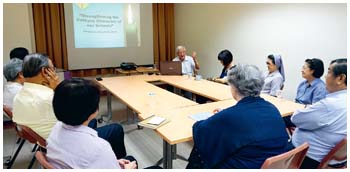
In his short meetings with school supervisors, school management committee members, chaplains and parent volunteers, Jesuit Fr Christopher Gleeson emphasised the need for faith formation.

Just as people have personal trainers for the body, there needs to be “personal training for the soul”, he stressed.

“The riches of our Catholic faith lie in our spiritual tradition,” he added.

During his 17 March session with school chaplaincy teams and parent volunteers, he shared about potential resources that Catholic schools here could use for the faith formation of teachers and students.

He also spoke about how students at one of the Jesuit schools in Australia went through a series of formation sessions in order to become Eucharistic ministers, a role that the students took seriously.

Meeting with school supervisors, school management committee chairmen and principals on March 18, he reiterated the need to tell the stories of schools’ Religious founders, pointing once again to the Emmaus story as a model of accompaniment.

Encouraging school board retreats, he said, “One’s own depth of spirituality as a school governor is a crucial element in the Catholic life of a school.”

Stated Fr Gleeson, “Never underestimate the power of the Catholic tradition or the congregational story as a lens on the Gospel,” adding that Christian communities that are not Catholic do not have the powerhouse that Catholics have because of their Religious traditions.

Ms Leslie Goonting, a parent volunteer said of the session, “I think we are empowered a bit more to know about what is happening in Australia. We have an idea of what’s available here and where the gaps are.” She hopes that “Catholic school leaders will more strongly embrace and prioritise the need for spiritual formation of the children and youth they serve and to also introduce all teachers and staff to what Catholic education is and form them accordingly.


By Mel Diamse-Lee, Catholic News.
Source: Catholic News, April 5, 2015, Volume 65, Number 07