So, we know our God is a Triune God. Now which Person of the Holy Trinity do you relate to most easily or most often?
Or perhaps some of us relate best to Jesus, who is easy to picture as a friend who walks beside us or as a shepherd who leads us to rest in green pastures. Sometimes, when I am feeling down, I imagine Jesus coming up from behind, placing his arm round my neck and speaking words of affirmation and assurance, and instantly I experience his warmth and closeness.
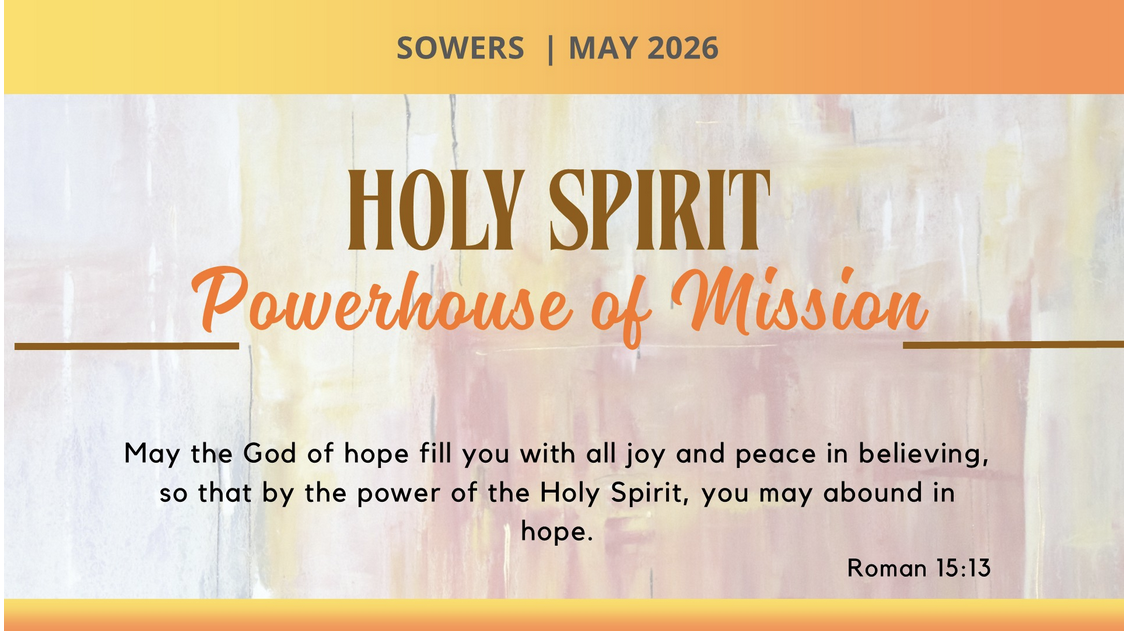
But unlike the Father and the Son, the Holy Spirit, I suspect, can be somewhat difficult to relate to for many of us. And the symbols used of him in the Scriptures aren’t very helpful in this regard – a dove isn’t particularly cuddly, and the wind and fire of Pentecost can make him appear more dramatic or scary than approachable. This, unfortunately, often leads to the Holy Spirit being neglected – some may even forget he is God and refer to him as “it”.
Agent of Communion
True, we don’t often picture the Holy Spirit as a Person, the way we do the Father and the Son. At most, we may think of him as a bird flying overhead or an invisible force that moves within us and across the world.
Nevertheless, the truth is that the Holy Spirit manifests himself in the Body of Christ and in the world in tangible ways. See the community worshipping God together in a song of praise? That’s the Holy Spirit at work. See people using their gifts and talents to serve the community? There’s the Holy Spirit too. See estranged friends, relatives or colleagues being reconciled? Again, the Holy Spirit.
Indeed, the Holy Spirit plays a crucial role as the agent of communion within the Church, fostering unity among believers and enabling us to live as the Body of Christ. And the communion he brings about is multidimensional:
- Communion with God and with neighbour: The Spirit breaks down barriers of sin and division and enables us to be drawn into deeper communion with God and with one another.
- Eucharistic communion: The Spirit is intimately involved in the celebration of the Eucharist, through which we partake of the divine life and are united with Christ and with one another.
- Communion in the Church’s life: The Spirit sustains the life of the Church by inspiring harmony in her teachings, sacramental life and hierarchical structure.
Communion in Mission
In the Church, we come from diverse backgrounds, and the Holy Spirit binds us together as one family in Christ. The unity we share in the Church is not uniformity – this is something I believe we all know but can easily forget when we have to work and interact with brothers and sisters who think or behave differently from us.
Instead, what the Spirit creates from our diversity is a rich tapestry of gifts and charisms working together for the common good:
“The gifts he gave were that some would be apostles, some pastors and teachers, to equip the saints for the work of ministry, for building up the body of Christ.” (Ephesians 4:11–12 NRSV)
And in the body of Christ, “God arranged the members in the body, each one of them, as he chose” (1 Corinthians 12:18 NRSV).
After teaching us that we are all members of the body of Christ, St Paul says, “Strive for the greater gifts. And I will show you a still more excellent way.” (1 Corinthians 12:31 NRSV) And then he goes on to talk about love:
“Love is patient and kind; love does not envy or boast; it is not arrogant or rude. It does not insist on its own way; it is not irritable or resentful; it does not rejoice at wrongdoing, but rejoices with the truth.” (1 Corinthians 13:4–6 ESV)
We need to ask ourselves then: How much of this description applies to me? Am I patient and kind, or arrogant and rude? Do I insist on my own way, or do I rejoice with the truth? After all, the common good is what we are working for, not our own individual good; the body of Christ is all of us together, and we cannot say to anyone, ‘I have no need of you’ (1 Corinthians 12:21 NRSV); and the kingdom we are building is God’s, not ours.
Friendship with the Spirit
And here’s where the Holy Spirit comes in again. His grace is what we need to achieve this ideal state, to work with one another in true communion in mission. And in the process of fostering communion, he does his work in each of us personally, softening our hearts, moulding our minds, forming in us the image of Jesus.
This is just what I have experienced. As I look back over the years, I can see how far I have come – how much my outlook and my ways have changed. And every morning I still pray for the grace to cooperate with the Spirit’s grace as he continues to lead me and guide me and shape me.
We may not imagine ourselves snuggling up to him, but the Holy Spirit, Lord and giver of life, is without doubt our true friend, our steadfast companion, our indispensable guide. If you have yet to discover the joys of his friendship, why not ask him for that gift today?