A Seed Planted, A Journey of Faith Begins by Nick Chui and Brandon Law
“Brothers, what we do in life… echoes in eternity.” This quote from the movie Gladiator always struck me as very Christian. Maximus the gladiator was a pagan, yet he had intuited that actions on earth do matter.
In some way, this was also my own teaching motto.
“What I teach in time echoes in eternity.” And as a Catholic educator, this is even more so in the light of the Resurrection.
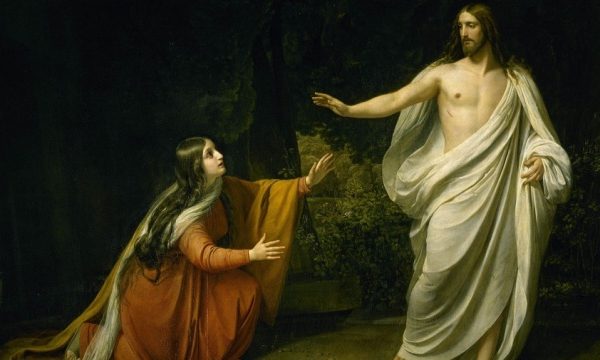
When our Lord rose from the dead, he inaugurates the beginning of the new heavens and the new earth, where every tear would be wiped away.
In the Dec 2025 issue of the Sowers, I shared about how as a Catholic educator, the deepest joy would be seeing your former students find their direction in life, and come to accept Jesus Christ as the way, truth and life.
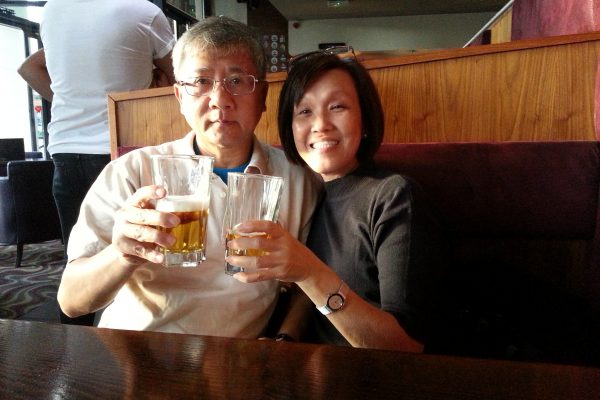
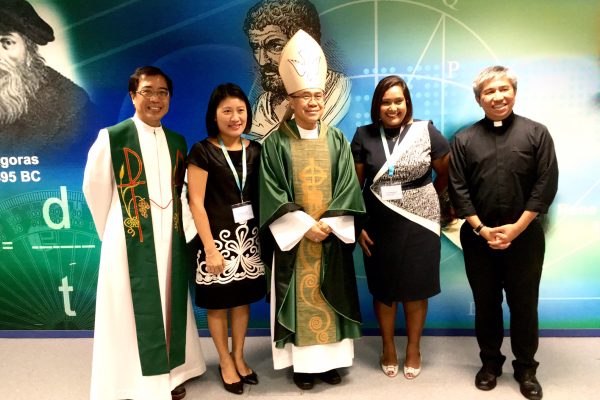
Fast forward to April 2026, and I find myself with the immense privilege of witnessing, as his godfather, my ex-student Brandon Augustine Law, accepting Christ and being baptised at the Easter Vigil.
What follows is his own reflection on the mystery of the Resurrection in the light of his own journey to accepting Christ.
May it be a source of consolation and inspiration to my fellow Catholic educators!
Initial disbelief and error
Resurrection, or delusion? Before my conversion, I certainly felt it was the latter. I did think that the man Jesus Christ taught some relevant moral lessons, but he could not possibly have been divine. That, I chalked up to delusion. It proved beneficial to occasionally invoke some of his teachings. I sometimes felt the need to ‘turn the other cheek,’ or ‘go the extra mile,’ but saying this man rose from the dead? That would be too far.
Religion seemed to me to be a tool for maintaining order, and I felt I did not need to comply. In my arrogance, I believed that God spoke some truth about morality but somehow lied about who he was; I took from Christianity what was expedient to myself and discarded the rest as make-believe. In my blindness I could not see that I was the one making up my beliefs. As the Psalmist writes: My heart overflowed with follies, and I set my mouth against the heavens.
I observed devout Christians living out the Catholic faith in the hope of a resurrection that, I believed, would not come, and I could not help but find it foolish. Do they not see how they are being controlled? Have they not a mind of their own? My modern sensibilities could not process true piety.
Absurdity to possibility
One day, I got into a discussion with a Christian friend. We were talking about what it meant to be a ‘good person’. To me it was uncontroversial to call my friends ‘good people’ whereas this Christian seemed adamant in his view that no one was good. “Jesus himself said so,” I remember him telling me.
I was incredulous. We see good people around us all the time, and even though we might class some under ‘bad’, surely saying that no one is good is too extreme.
The position is, by worldly standards, a radical one. But this seemingly untenable – and almost provocative – statement that no one is good somehow acted as a catalyst to awaken me from my slumber:
It made me realise I was a sinner.
Of course this didn’t happen overnight, and I did mull over it for quite a while. I hadn’t thought I was perfect, but I couldn’t have been that bad. Then I realised what the more untenable position was: That one could be without sin.
Believing that I was good enough, and without belief in the promise of the Resurrection, I had really arrogated to myself sanction to do as I pleased. You only live once, I thought, and so what a waste it would be to glorify God instead of being freed from the absurdity of religion. I had witnessed true devotion, but to me it seemed to be in vain that they kept their hearts clean and washed their hands in innocence.
Yet from this Copernican Revolution of sorts, the absurdity and delusion of my friend’s position overturned my “enlightened” worldview; I turned out to be the absurd and deluded one.
No one is good. Those were indeed the words of our Saviour. But that alone would be incomplete, for he followed that with but God alone.
If I am not a good person – or rather: If I am with sin, how might I be saved? No longer some absurd delusion, my heart was stirred to explore this source of goodness, the Good itself. This would soon lead me to the Good News, and our Lord’s Resurrection.
Confronting my error
And so, it took this work of God for me to confront the depths of my error. I saw that I was in fact creating my own truth by picking and choosing what I liked and disliked about God. I surely cannot be said to be coming to truth itself. Compelled to see who Jesus Christ really said he was, I turned to Scripture and there I found my answer: “Truly, truly, I say to you, before Abraham was, I am.”
In that moment, Jesus himself spoke to me. He was not merely an enlightened teacher with a few teachings that are relevant to our times, nor was he simply a prophet of God whose words we try to superimpose onto our worldview. He simply is. The same God who spoke to Moses at the burning bush now spoke to me in the same way. The same God who was in the beginning. Who else could have saved me from my error, and showed me the truth? For indeed he is Truth itself, he who is.
This is the true Jesus Christ, who said he rose again in the flesh, and who has overcome the world. As it turned out, I really was the one that had believed in delusions. These fantasies by which I, in deciding on what is good by my standards, usurped the proper place of the Creator. By an act of God, I was made to confront the truth of the Resurrection.
The RCIA journey; the mercy of God
I continued to pursue this truth where it led, and feeling a real desire to be baptised into the Catholic Church, I began my RCIA journey. Even though I sometimes found the process unnecessarily drawn-out, I gradually came to appreciate the intentional symbolism behind the process that would culminate at Easter. Of course, not without the help of my sponsor and godparent, Mr Nick Chui throughout.
The Liturgical Calendar would play an important role in determining the direction of my life, especially spiritually: During Ordinary Time, as focus was placed on the public life and ministry of Jesus Christ, my trust in God grew steadily. I pondered over the prophecies about the coming of our Lord in the flesh, and reflected on his Second Coming during Advent, and contemplated the mystery of the Incarnation during Christmastide. During Lent, I do penance and prepare for Good Friday and the festivities of Easter, along with my own baptism. As the faith became a part of my daily life, what was once simply propositional, having to do with statements and logic, has become something profoundly real to me.
Conclusion
As Easter approaches, I am confronted with the great mercy that God has shown me as I contemplate the Resurrection… (continues with scriptural reflections and ends with gratitude and affirmation of faith)